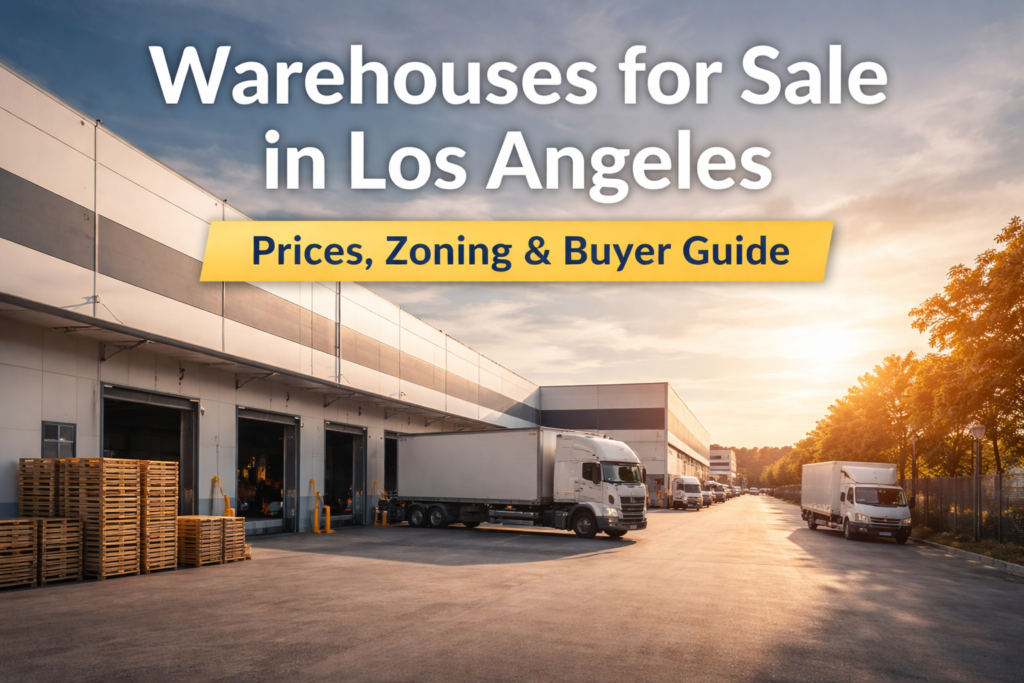
Warehouses for Sale Los Angeles | Prices, Zoning & Buyer Guide
By Jacob Lavian | Los Angeles Commercial Real Estate
What this guide covers: If you’re looking for warehouses for sale in Los Angeles, this page breaks down what buyers need to know about pricing, zoning, electrical power, environmental issues, building functionality, financing, and the best Los Angeles industrial submarkets to watch.
If you’re searching for warehouses for sale in Los Angeles, you’re entering one of the most competitive industrial real estate markets in the country. From small owner-user buildings to larger distribution facilities, Los Angeles offers a wide range of warehouse opportunities, but finding the right property requires more than just browsing listings. Buyers need to understand zoning, electrical capacity, environmental risks, loading configurations, and pricing before they move forward. This guide explains what to look for before buying a warehouse in Los Angeles so you can make a smarter decision and avoid expensive mistakes.
Demand for warehouses for sale in Los Angeles remains strong because the city sits at the center of logistics, manufacturing, wholesale distribution, and e-commerce activity. Businesses want proximity to the ports, major freeways, dense consumer populations, and labor. Investors want stable industrial demand and limited land supply. Owner-users want to control occupancy costs and build equity instead of paying rent forever. All of that competition is exactly why buyers have to be careful. In industrial real estate, a property can look attractive online and still be completely wrong once you dig into the details.
Buying a warehouse is not like buying a house. Two buildings with similar square footage can have dramatically different value depending on clear height, truck access, power, sewer setup, zoning, and prior use. A warehouse that works well for storage may not work for light manufacturing. A building that looks inexpensive on a price-per-square-foot basis may require major electrical upgrades or environmental work. That is why a buyer needs a real understanding of the building itself, not just the asking price.
Warehouses for Sale in Los Angeles: What’s Available Right Now?
Buyers searching for warehouses for sale in Los Angeles will usually find several broad categories of industrial property. Some are small owner-user buildings in older infill neighborhoods. Others are larger industrial properties built for warehousing, distribution, or light manufacturing. Depending on the submarket, you may also come across flex buildings, creative industrial space, industrial condos, and commercial warehouse buildings that have been adapted over time for mixed operational use.
Common buyer searches in this market include:
- Small warehouse for sale Los Angeles for owner-users who need a base of operations
- Commercial warehouse for sale Los Angeles for storage, wholesale, or distribution businesses
- Industrial property for sale Los Angeles for manufacturing, logistics, and operational businesses
- Warehouse for sale Los Angeles County for buyers open to nearby industrial cities and surrounding areas
That is one reason broad content around Los Angeles industrial real estate can perform well. People use different search terms, but they often want the same thing: a warehouse or industrial building they can occupy, lease, improve, or hold as an investment. Building a page that addresses these related variations gives you a better chance of ranking for multiple keywords instead of just one.
Why Los Angeles Is Such a Strong Industrial Market
The Los Angeles industrial market is one of the most important in the country. Demand is driven by global trade, local manufacturing, regional distribution, media production, wholesale trade, and e-commerce. Businesses that need to move inventory quickly want to be near the ports, major freeway networks, and customer bases throughout Southern California. That is a major reason industrial property for sale in Los Angeles continues to attract both users and investors.
Los Angeles also benefits from supply constraints. In many submarkets, there is not much new land left for large industrial development. That means existing warehouses often carry a premium because they are difficult to replace. Even older buildings can remain valuable if they have functional loading, good freeway access, and zoning that supports the buyer’s use. For owner-users, buying a warehouse can create long-term stability. For investors, industrial properties can offer steady demand and attractive fundamentals when purchased correctly.
Still, this is not a market where buyers should assume every industrial building is a good acquisition. The wrong building in the wrong location can limit operations, create expensive improvement costs, or slow resale potential later. That is why buyers should understand the fundamentals before committing.
Average Price of Warehouses for Sale in Los Angeles
One of the most common questions buyers ask is simple: what do warehouses for sale in Los Angeles actually cost? The answer depends heavily on size, location, building functionality, land value, and whether the property appeals more to investors or owner-users. Smaller industrial buildings often trade at a higher price per square foot because more buyers can afford them and because they are popular with local businesses that want to own instead of lease. Larger properties may trade differently depending on tenancy, loading, yard, and clear height.
In many parts of Los Angeles, buyers should pay close attention not just to the asking price but to what that price represents. Is the property priced as a usable industrial building, as a land play, as an investment with in-place income, or as a value-add opportunity? A building with functional three-phase power, good truck access, and a clean use history is very different from a tired building that needs environmental review, roof work, and panel upgrades. When comparing warehouses for sale in Los Angeles, buyers should always look beyond headline pricing and study the actual condition and utility of the property.
If you are comparing options, this is where local guidance matters. Reviewing recent comparable sales, current competition, and the specific appeal of each building is much more useful than relying on broad averages. A buyer looking for a commercial warehouse in Los Angeles should always measure price against functionality.
Best Areas to Find Warehouses for Sale in Los Angeles
Location matters enormously in industrial real estate. Buyers looking for warehouses for sale in Los Angeles should understand that each industrial pocket serves different types of users. Some areas are known for traditional manufacturing. Others are better for logistics, small contractors, apparel, food-related businesses, or owner-users who need central access.
Vernon
Vernon is one of the most recognized industrial markets in the region. It is centrally located and heavily industrial in character, making it attractive for food production, cold storage, manufacturing, and distribution users. Buyers looking for highly functional industrial property often keep Vernon at the top of their list.
Commerce
Commerce is another major industrial area with strong access to transportation infrastructure. Buyers looking for distribution and logistics properties often focus here because of freeway access and established industrial activity. This submarket can be especially attractive for businesses serving a wide Southern California footprint.
South Los Angeles
South Los Angeles includes many older infill industrial properties that can work well for small to mid-size owner-users. Building quality varies, but there are often opportunities for buyers who understand how to evaluate older warehouse stock. For some businesses, these areas offer a practical entry point into ownership.
San Fernando Valley
The San Fernando Valley offers a mix of industrial and flex space that appeals to service businesses, light manufacturing, media-related users, and owner-users who want proximity to Valley labor and customer bases. Buyers searching for small warehouse for sale Los Angeles often widen their search into Valley submarkets for additional options.
Each area has different pricing, building inventory, zoning considerations, and operational tradeoffs. A good Los Angeles industrial search is never just about finding a building. It is about finding the right building in the right submarket for the intended use.
Understanding Zoning Before You Buy
Zoning is one of the most important parts of any warehouse purchase. Buyers looking at warehouses for sale in Los Angeles need to confirm that the property legally allows the intended use. This should happen early, not after the buyer is emotionally attached to the building or deep into escrow. A warehouse may look perfect operationally and still be a bad fit if the zoning does not align with the business plan.
M1 – Light Manufacturing
M1 zoning is common in Los Angeles industrial areas and often allows warehousing, light manufacturing, assembly, wholesaling, and related uses that do not create heavier nuisance impacts. Many buyers searching for industrial properties in Los Angeles will end up looking at M1-zoned buildings because they fit a broad range of business uses.
M2 – Heavy Manufacturing
M2 zoning allows heavier industrial activity and may be required for uses that involve more intense operations, equipment, noise, or byproducts. If a buyer’s intended use includes heavier fabrication or specialized industrial processes, M2 may be necessary.
Other Industrial and Commercial Manufacturing Zones
Some warehouse properties fall into other categories such as CM or specialized manufacturing zones. Those designations may come with restrictions on outdoor storage, operating intensity, parking, or other factors. Buyers should never assume a property is suitable just because it has historically been used as a warehouse. The exact permitted use matters.
Anyone serious about buying a warehouse should verify zoning through city resources and through professionals who understand industrial transactions. If a use requires a conditional permit or variance, that can change the timeline and risk profile of the entire deal. This is one area where working with a Los Angeles commercial real estate broker can save buyers from painful mistakes.
Pro Tip: Before making an offer, confirm not only the zoning code but also whether your exact intended use is permitted by right. Warehousing, distribution, fabrication, food production, cannabis-related uses, and auto-related operations can all trigger different rules.
Small Warehouse for Sale Los Angeles: What Buyers Should Expect
Many buyers are not looking for a giant logistics facility. They are looking for a practical owner-user building where they can run a business, store equipment, receive deliveries, or hold inventory. That is why the keyword small warehouse for sale Los Angeles can be valuable. Smaller buildings often attract business owners who want to stop leasing and start controlling their own real estate.
These buildings may range from a few thousand square feet up to roughly 10,000 or 15,000 square feet, depending on the submarket. Some are standalone warehouse buildings with office buildout and one or two loading doors. Others are older industrial buildings that need cosmetic or functional improvements. Many have limited yard, lower clear height, or older power configurations, so buyers need to evaluate whether the building truly works for their operation.
The biggest mistakes small-building buyers make are assuming all industrial square footage is equally useful and overlooking future needs. If you expect to add staff, equipment, racking, refrigeration, or a small fleet later, the right building today should still support those needs tomorrow. A low price does not help if the building becomes obsolete for your business in two years.
Electrical Power: A Warehouse Can Look Fine and Still Be Wrong
Power is one of the most overlooked factors when buying a warehouse. Buyers often focus on square footage and location first, but the electrical setup can make or break the usefulness of the building. A warehouse can appear to be a bargain and still require a costly upgrade if the service is insufficient for the intended operation.
Single-Phase vs. Three-Phase Power
Most industrial users prefer or require three-phase power. It is more efficient for running heavier machinery, compressors, larger HVAC systems, refrigeration, and production equipment. If you are looking at warehouses for sale in Los Angeles for manufacturing, processing, fabrication, or higher-volume operations, this is a question you need answered immediately.
Amperage Matters Too
A building may have three-phase service and still not have enough amperage. A buyer should verify actual panel capacity, available breaker space, and whether the existing service fits current and future needs. Electrical upgrades can be expensive, time-consuming, and sometimes more complicated than buyers expect.
Future Capacity
Even if the existing setup works now, buyers should think ahead. If your business may add machinery, cooling, EV charging, or more intense equipment later, you want a building that gives you room to grow. One of the advantages of owning industrial real estate in Los Angeles is controlling your future. But that only works if the building can evolve with you.
Environmental Issues: Floor Drains, Use History, and Phase 1 Reports
Environmental review is a major part of buying industrial property. A warehouse with a long use history can carry hidden risk even when the building looks fine on the surface. Buyers considering warehouses for sale in Los Angeles should always pay attention to prior use, floor drains, underground storage tanks, and any history of chemical, automotive, or industrial activity that may have affected the site.
Why Floor Drains Matter
Floor drains can become an issue because they may have received oils, chemicals, or other materials over decades of use. In an industrial context, the concern is not just the existence of a drain. The concern is where it goes and what may have gone through it in the past.
Phase 1 Environmental Site Assessment
A Phase 1 Environmental Site Assessment reviews the history of the property, public records, maps, aerials, databases, and site observations to identify possible environmental concerns. Lenders commonly require it, but even cash buyers should usually order one on industrial property. It is a standard part of competent due diligence.
When More Investigation Is Needed
If the Phase 1 identifies recognized environmental conditions, additional testing may be recommended. That can lead to a Phase 2, which involves actual sampling and laboratory work. Buyers should never treat this casually. A problem discovered after closing is far more expensive than a problem discovered while contingencies are still open.
This is especially true if you are considering an abandoned warehouse for sale in Los Angeles or any building with unclear history. Vacancy, deferred maintenance, stripped systems, and undocumented prior uses all increase uncertainty.
Important: Environmental due diligence is not optional just because a building looks clean. Many industrial issues are invisible until records are reviewed and the right experts inspect the property.
Clear Height, Loading, and Functional Warehouse Features
Industrial real estate is all about functionality. Buyers comparing warehouses for sale in Los Angeles should pay close attention to the basic physical features that affect daily operations.
Clear Height
Clear height determines how much usable vertical storage space you have. Higher clear height generally means more flexibility for racking and storage. Older Los Angeles industrial buildings may have lower clear heights than newer facilities, and that can matter a lot depending on your use.
Dock-High vs. Grade-Level Loading
Some users need dock-high loading for truck efficiency. Others can function well with grade-level doors. The right configuration depends on how goods move in and out of the building. Distribution-heavy operations usually care much more about dock loading than smaller service businesses do.
Column Spacing and Layout
A warehouse with poor column spacing can create operational inefficiency even if the square footage looks good on paper. Buyers should think about equipment placement, circulation, forklift movement, pallet layout, and whether the building feels genuinely usable.
Truck Court and Yard
If your operation involves truck circulation, outdoor storage, or staging, the yard and truck court matter. Many older infill buildings in Los Angeles have limited outdoor maneuvering space, which can be a problem for certain users.
Office Buildout
Some buyers want minimal office space. Others need a stronger front-office component with meeting rooms, dispatch, employee areas, or multiple private offices. The existing buildout can save money if it fits your needs, or create reconfiguration costs if it does not.
Title, Easements, and Ownership Issues Buyers Should Review
When buying a warehouse, title review matters just as much as the physical inspection. Buyers should make sure escrow and title professionals identify liens, easements, encroachments, access issues, and any other recorded matters that could impact value or use. A driveway easement, shared access arrangement, or old recorded restriction may affect how the site functions in practice.
Buyers looking at industrial property in Los Angeles should also confirm parcel configuration, legal access, parking rights, and whether any improvements appear inconsistent with title or survey information. Industrial buyers often focus so heavily on operations that they forget the legal side of the property itself.
Financing a Warehouse Purchase in Los Angeles
Warehouse financing is different from residential financing. Buyers often use SBA 504 loans, conventional commercial loans, or shorter-term bridge financing depending on whether the property is owner-user or investment-oriented. The right financing structure depends on occupancy, business strength, down payment, and the condition of the property.
SBA 504 for Owner-Users
For owner-users, SBA financing can be one of the strongest options because it may allow lower down payments and longer-term fixed-rate debt. Businesses looking for a small warehouse for sale Los Angeles often explore SBA because the program can make ownership more accessible.
Conventional Commercial Loans
Traditional commercial lenders usually require more equity than residential lenders and pay close attention to both the borrower and the asset. Building condition, environmental results, occupancy, and use all matter during underwriting.
Bridge Financing
Bridge or private money may be used when a property needs work, needs to close quickly, or does not qualify for standard debt immediately. These loans can be useful, but buyers need to understand the cost and the exit plan clearly.
Why Working With the Right Broker Matters
Buying a warehouse in Los Angeles is not just about finding something online. Good industrial brokers help buyers interpret functionality, identify red flags, compare submarkets, and structure stronger offers. They can also help buyers access opportunities before they are widely exposed.
An experienced Los Angeles commercial real estate broker can help with:
- Understanding current market pricing and competition
- Evaluating which submarkets fit the intended use
- Reviewing zoning and use issues early
- Connecting buyers with inspectors, lenders, environmental consultants, and escrow professionals
- Helping buyers negotiate price, contingencies, and timing
If you are seriously searching for warehouses for sale in Los Angeles, professional guidance can save time and reduce risk at every stage of the process.
Common Mistakes Buyers Make When Looking at Warehouses for Sale in Los Angeles
- Focusing only on price per square foot. A cheaper building can become far more expensive once upgrades and due diligence costs appear.
- Not confirming zoning early enough. A warehouse is only useful if it legally supports your intended use.
- Ignoring electrical capacity. Power limitations can kill a deal or create major post-closing costs.
- Skipping serious environmental review. Industrial history matters, even if the building looks clean today.
- Underestimating layout issues. Clear height, loading, truck access, and yard are all operationally critical.
- Buying too small. Many owner-users outgrow buildings faster than they expect.
- Treating all submarkets the same. Different parts of Los Angeles serve very different industrial users.
Warehouses for Sale in Los Angeles – Frequently Asked Questions
Are warehouses for sale in Los Angeles a good investment?
They can be, especially when the building has strong functionality, a good location, and realistic pricing. Industrial property in Los Angeles benefits from long-term demand drivers including trade, distribution, and land scarcity. The quality of the specific deal still matters.
What is the difference between a warehouse and industrial property in Los Angeles?
The terms are often used interchangeably, but industrial property is broader. It can include warehouses, manufacturing space, flex buildings, service industrial space, and other operational real estate.
What should I look for in a small warehouse for sale in Los Angeles?
Focus on zoning, loading, power, parking, office buildout, and whether the building can still support your business as it grows. Smaller owner-user buildings are often in high demand, so functionality matters even more.
Do I need a Phase 1 report when buying a warehouse?
In many cases, yes. Most lenders require it, and even cash buyers should strongly consider it when purchasing industrial real estate. It is one of the most important parts of due diligence.
How do I find warehouses for sale in Los Angeles that actually fit my business?
The best approach is to define your operational requirements clearly first, then search by size, power, zoning, loading, and location rather than by price alone. Working with a local broker can help narrow the field much faster.
Next Steps for Buyers
Buyers searching for warehouses for sale in Los Angeles should approach the process with a clear checklist. Know your size requirements, power needs, parking and loading needs, and exact intended use. Confirm zoning early. Review environmental history. Compare locations carefully. Do not treat industrial buildings as interchangeable, because they are not.
The Los Angeles market offers real opportunity for buyers who know how to evaluate industrial real estate properly. Whether you are looking for a warehouse for sale in Los Angeles, a commercial warehouse in Los Angeles, or a Los Angeles industrial broker to help guide the search, the key is making sure the building matches the business plan from day one.
If you want help evaluating warehouses for sale in Los Angeles or narrowing down the right industrial properties for your goals, contact Jacob Lavian to start the conversation.