By Jacob Lavian | Los Angeles Real Estate
Buying or selling a home in Sherman Oaks involves more than finding the right property or choosing an asking price.
A hillside home with beautiful views might present unexpected insurance challenges. Two houses with similar square footage can command very different prices depending on their neighborhood, lot, condition, and layout. And for homeowners preparing to sell, the difference between the sale price and the amount they actually receive can be substantial.
Whether you’ve owned your Sherman Oaks home for 30 years, you’re considering selling in the near future, or you’re looking to purchase a single-family property, understanding these factors can help you make better financial decisions.
This guide covers four important questions affecting Sherman Oaks real estate in 2026:
- How can wildfire insurance affect buying or selling a hillside home?
- What does it actually cost to sell a home in Sherman Oaks?
- How do Sherman Oaks neighborhoods such as Chandler Estates and Fashion Square compare?
- How can you determine what your Sherman Oaks home is really worth?
1. Selling a Home in the Sherman Oaks Hills: Fire Insurance and Escrow Challenges
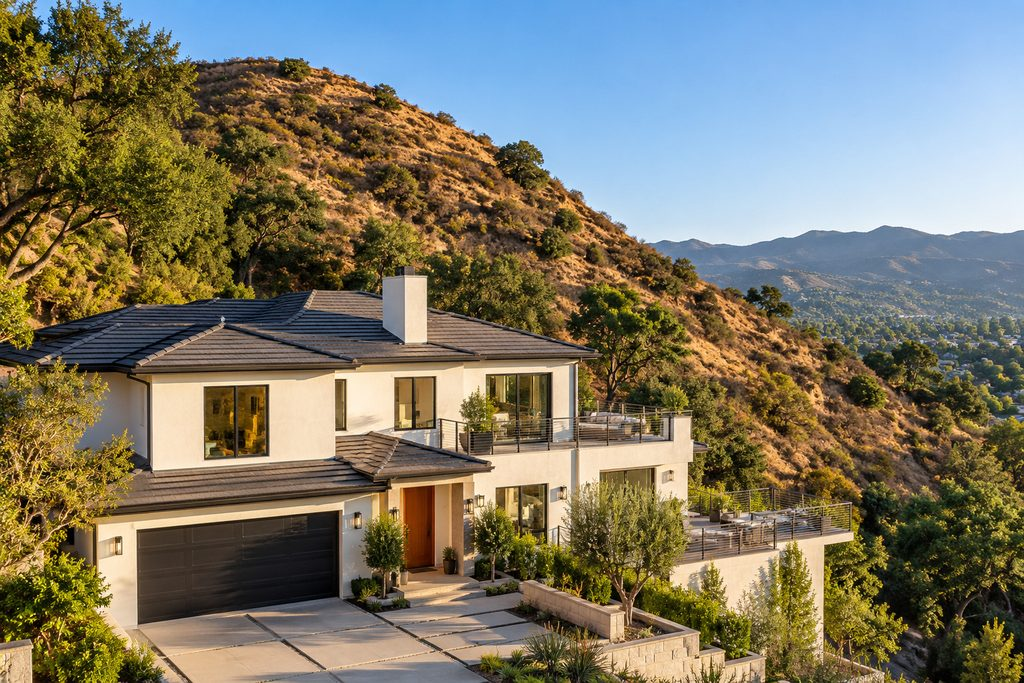
The Sherman Oaks hills offer some of the area’s most distinctive properties, including homes with canyon views, larger lots, architectural designs, and access to the Santa Monica Mountains.
But hillside ownership can come with considerations that buyers and sellers of more conventional properties may not anticipate.
One of the most important is homeowners insurance.
Why Fire Insurance Matters When Selling a Hillside Property
Some homes in the Sherman Oaks hills are located within designated fire hazard severity zones.
These designations can affect the availability of insurance, vegetation-management obligations, and certain disclosures required during a sale.
Even when a buyer qualifies for a mortgage and agrees to the purchase price, obtaining adequate homeowners insurance can become an important part of the transaction.
A buyer might discover that their preferred insurance company will not provide coverage, that the available policy is more expensive than expected, or that supplemental coverage is necessary.
These circumstances can affect a buyer’s monthly housing costs or their ability to satisfy a lender’s insurance requirements.
A property can be desirable, properly priced, and in good condition yet still encounter insurance-related complications during escrow.
That doesn’t mean hillside homes cannot be sold. It means insurance deserves attention before the transaction reaches a critical deadline.
What Is the California FAIR Plan?
The California FAIR Plan provides access to basic property insurance for homeowners who cannot obtain appropriate coverage through the traditional insurance market.
It is generally intended as an insurer of last resort.
An important detail is that a FAIR Plan policy does not automatically provide all the protections included in a typical comprehensive homeowners policy.
For example, coverage for liability, theft, and certain types of water damage may require separate insurance.
Homeowners may be able to supplement FAIR Plan coverage with a Difference in Conditions (DIC) policy.
Because coverage terms, premiums, and availability vary, buyers should consult a licensed insurance professional rather than assume a particular property will qualify for a specific policy.
For additional information, visit the California Department of Insurance’s residential insurance resources.
What About Brush Clearance and AB 38?
California also has disclosure and defensible-space requirements that may apply to certain properties in designated fire hazard severity zones.
AB 38 is particularly relevant to sellers whose homes fall within applicable high or very high fire hazard areas.
Depending on the location and jurisdiction, homeowners may need to address defensible-space compliance documentation, fire-hardening disclosures, and vegetation-management requirements.
The Los Angeles Fire Department provides resources for checking fire-zone status and navigating applicable requirements.
Homeowners can learn more through the LAFD’s AB 38 and Fire Zone information.
Before listing a hillside property, it makes sense to determine which requirements apply to the actual address rather than assume every home south of Ventura Boulevard is treated the same way.
What Should Sellers Do Before Listing?
If you’re preparing to sell a Sherman Oaks hillside home, consider taking these steps before accepting an offer:
- Verify the property’s fire hazard designation and applicable brush-clearance requirements.
- Review the property’s existing insurance coverage and any nonrenewal notices.
- Ask a licensed insurance broker about potential coverage options for a new purchaser.
- Gather relevant roof, maintenance, vegetation-management, and property-improvement documentation.
- Discuss insurance-related contingencies and transaction timing with your real estate agent.
Sellers cannot guarantee what a buyer’s insurer will offer. However, identifying possible obstacles early can reduce surprises later.
For older hillside properties, it may also be useful to review my article on whether to get a pre-listing inspection before selling in Los Angeles.
2. How Much Does It Cost to Sell a House in Sherman Oaks?
When homeowners consider selling, their first question is usually:
How much can I get for my house?
But there’s another question that deserves just as much attention:
How much money will I actually walk away with after the sale?
The selling price is only one part of the equation.
Brokerage compensation, transfer taxes, escrow and title expenses, repairs, negotiated buyer credits, and any outstanding mortgage balance can all affect the final amount.
Real Estate Brokerage Compensation
Brokerage fees are negotiable. There is no legally required or standard commission rate.
The compensation a seller agrees to pay depends on the services being provided and the terms negotiated with the brokerage. Compensation arrangements involving a buyer’s representative must also be evaluated under the applicable agreements and transaction requirements.
Sellers should understand exactly what services are included in their listing agreement and how compensation will be handled.
Los Angeles Transfer Taxes
Sherman Oaks is within the City of Los Angeles, which has both city and county real property transfer taxes.
As of October 2026, the general City of Los Angeles transfer tax is approximately 0.45% of the property’s value, with an additional Los Angeles County documentary transfer tax of approximately 0.11%.
For illustration, a $1,500,000 sale would generally produce approximately:
| Transfer tax | Estimated amount |
|---|---|
| Los Angeles City transfer tax | $6,750 |
| Los Angeles County documentary transfer tax | $1,650 |
| Combined transfer taxes | $8,400 |
These figures assume an ordinary taxable transfer with no applicable exemptions or unusual circumstances. Responsibility for payment may depend on the contract and transaction.
How Measure ULA Affects Higher-Priced Homes
For luxury properties, another important consideration is Measure ULA, sometimes referred to as the Los Angeles mansion tax.
Effective July 1, 2026, the City of Los Angeles applies an additional transfer tax of:
- 4% for qualifying transactions greater than $5.4 million but less than $10.9 million.
- 5.5% for qualifying transactions of $10.9 million or more.
The additional ULA tax is generally calculated on the full taxable transaction value, not just the amount above the threshold, and is separate from ordinary city and county transfer taxes.
These thresholds are subject to periodic adjustment.
For a homeowner selling a high-value property in the Sherman Oaks hills, understanding the applicable tax before establishing a listing strategy can be financially significant.
Current information is available from the Los Angeles Office of Finance.
What Could a Sherman Oaks Seller Actually Walk Away With?
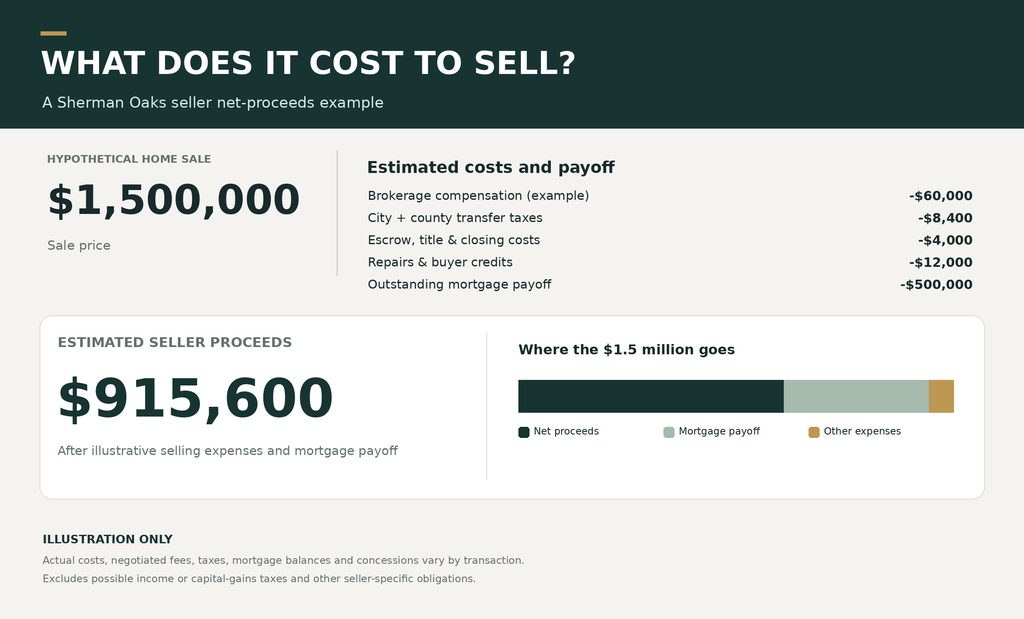
Consider a hypothetical homeowner selling a single-family property for $1,500,000.
| Item | Illustrative amount |
|---|---|
| Home sale price | $1,500,000 |
| Negotiated brokerage fees (example: 4%) | -$60,000 |
| City and county transfer taxes | -$8,400 |
| Escrow, title and miscellaneous closing expenses | -$4,000 |
| Repairs or negotiated buyer credits | -$12,000 |
| Outstanding mortgage payoff | -$500,000 |
| Illustrative seller proceeds | $915,600 |
These are example figures, not a quote or a prediction of actual costs. Brokerage fees are fully negotiable, other charges depend on the transaction, and the calculation excludes applicable income or capital-gains taxes and any additional liens or obligations.
The important takeaway is that a $1.5 million sale doesn’t mean the seller receives $1.5 million.
A realistic estimate should reflect the property’s expected selling price and the specific expenses associated with the transaction.
Should You Renovate Before Selling?
Another expense that deserves careful consideration is renovation.
Some homeowners assume a new kitchen, updated bathrooms, or extensive landscaping will always increase their profit.
That isn’t necessarily true.
If a renovation costs $75,000 but only increases the selling price by $50,000, the owner may end up financially worse off.
Other properties might benefit from relatively inexpensive improvements such as paint, minor repairs, updated lighting, or landscaping.
I explored this question in detail in my guide: Should You Renovate Before Selling Your Sherman Oaks Home or Sell As-Is?.
Before investing in major improvements, compare the probable sale price in the property’s current condition with the expected price after renovation, including carrying costs and construction risk.
3. Sherman Oaks Neighborhoods: Chandler Estates vs. Fashion Square vs. South of the Boulevard
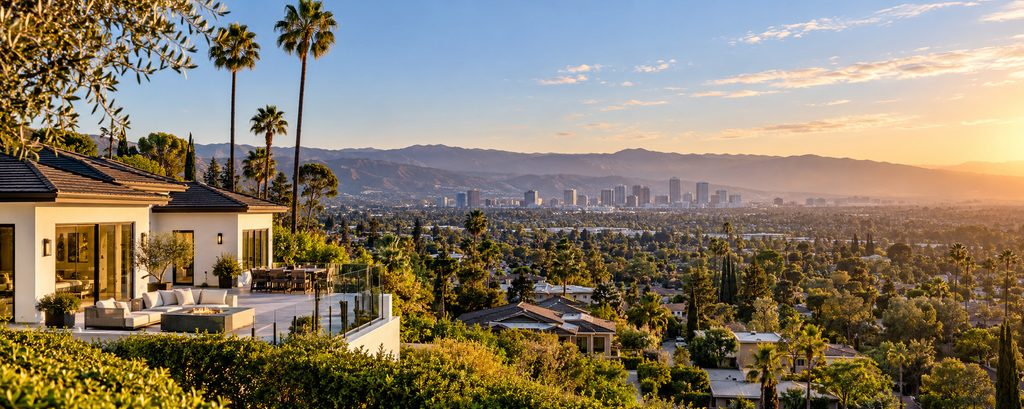
Not every Sherman Oaks neighborhood offers the same types of properties, surroundings, or lifestyle.
Homebuyers sometimes begin by looking at the city as a whole, but eventually discover that individual neighborhoods can feel quite different.
A house near Riverside Drive is not necessarily comparable to a hillside property above Ventura Boulevard, even if both have the same number of bedrooms and similar interior square footage.
Understanding the differences can help buyers narrow their search and help sellers select more relevant comparable sales.
Chandler Estates: Established Homes and Residential Character
Chandler Estates is an established residential pocket associated with the Chandler Boulevard area and nearby tree-lined streets.
The area is known for its history of single-family development and a mix of traditional residences, older homes, and remodeled properties.
Buyers considering this area may be interested in lot characteristics, mature landscaping, street appearance, and the ability to find established residential properties.
One detail worth understanding is that neighborhood names and postal boundaries in this part of the Valley have changed and sometimes overlap in everyday usage.
A home marketed as being near Chandler Estates should be evaluated using its actual address, parcel information, and location rather than relying only on a neighborhood label.
Fashion Square: Residential Streets Near Shopping and Services
The Fashion Square residential area is generally associated with streets near the Sherman Oaks Fashion Square shopping center.
A commonly referenced section lies around Hazeltine Avenue, Woodman Avenue, Riverside Drive, and Magnolia Boulevard.
The neighborhood contains a mixture of traditional single-family homes, renovated properties, and newer construction.
Its location places many properties relatively close to shopping, restaurants, and major Valley transportation routes.
However, the experience can vary considerably between individual streets.
For example, a property on a quiet interior residential street may offer a different setting from one immediately adjacent to a heavily traveled road or commercial development.
Buyers should evaluate traffic, noise, lot privacy, and the characteristics of nearby properties rather than relying solely on the neighborhood’s reputation.
South of Ventura Boulevard: Hillside Homes and Architectural Variety
South of Ventura Boulevard, Sherman Oaks includes established residential streets, hillside properties, and homes with a wide range of architectural styles.
Some properties offer canyon or city views, while others are situated on quieter residential streets with flatter lots.
The differences can be substantial even within a short distance.
A hillside home with a steep driveway, multiple levels, and a view may appeal to a different buyer than a traditional single-story property with a large, usable backyard.
Those physical differences also influence valuation, renovation costs, maintenance, and potentially insurance.
Comparing Sherman Oaks Neighborhoods
| Neighborhood | Characteristics to evaluate | Important buyer considerations |
|---|---|---|
| Chandler Estates area | Established residential streets, varied traditional homes, mature trees | Lot size, condition, boundaries, street characteristics |
| Fashion Square area | Single-family pockets near shopping and services | Traffic, noise, walkability, nearby development |
| South of Ventura Boulevard | Varied architecture, hillside and flatter residential properties | Views, topography, insurance, access, maintenance |
These are broad descriptions, not fixed neighborhood boundaries or price rankings.
Which Sherman Oaks Neighborhood Has the Best Home Values?
That depends on the property.
It’s tempting to rank neighborhoods according to their average selling prices, but average prices can be misleading.
One area might have larger lots or more newly constructed homes, while another contains mostly smaller original properties.
A meaningful comparison should account for:
- Recent closed sales of similar properties.
- Permitted living area, floor plan, and lot size.
- Property condition and quality of renovations.
- Street location, topography, noise, and privacy.
- School assignment verified for the specific address, when relevant.
- Buyer demand and competing listings.
A home in Fashion Square should not automatically be valued using a luxury hillside sale simply because both properties share a Sherman Oaks mailing address.
The same principle applies to Chandler Estates and other smaller residential pockets.
Real estate values are local, and sometimes the most meaningful differences occur from one street to the next.
4. How Much Is My Sherman Oaks Home Worth in 2026?
Homeowners can find estimated property values online within seconds.
Websites such as Zillow use automated valuation models to estimate property values using public records, market activity, and other available information.
These tools can be helpful as an initial reference.
However, an automated estimate isn’t necessarily the amount a qualified buyer would pay for a particular home today.
Why Online Home Estimates Can Miss Important Details
Consider two Sherman Oaks homes with the same reported living area, similar lot sizes, and the same bedroom count.
One has been extensively remodeled with permitted improvements, updated major systems, and a well-designed floor plan.
The other has original finishes, deferred maintenance, and an unconventional layout.
An automated valuation model may not fully capture those differences.
The same issue can arise with hillside properties.
A computer estimate may have difficulty accounting for the specific quality of a view, lot usability, driveway access, architectural appeal, or the impact of insurance availability.
Automated estimates can also be affected by inaccurate property records or recent improvements that haven’t been fully reflected in available data.
Zillow itself states that its Zestimate is not an appraisal and that accuracy varies depending on the information available.
What Actually Determines Your Home’s Market Value?
When estimating a property’s likely selling price, several factors deserve consideration.
Recent comparable sales: Homes that have actually sold provide useful evidence of what buyers have been willing to pay. The most relevant properties are generally those with similar characteristics, conditions, and locations.
Current competition: Active listings reveal what alternatives prospective buyers may be considering. A home can compare favorably with recent sales but still face significant competition from properties currently available.
Condition and improvements: Updated kitchens, bathrooms, roofing, systems, landscaping, and permitted additions may influence value, but the market doesn’t necessarily reimburse renovation costs dollar for dollar.
Lot and location: Street appeal, privacy, views, usable outdoor space, topography, and nearby surroundings can affect buyer interest.
Current market conditions: Financing costs, available inventory, and the number of qualified buyers competing for similar homes can change the appropriate pricing strategy.
A careful home valuation should consider all of these factors together.
Is a Home Worth More Because It Is South of Ventura Boulevard?
Not automatically.
Properties south of Ventura Boulevard may have location or physical characteristics that buyers value, including hillside settings, views, or distinct residential streets.
But those features must be evaluated against the home’s condition, layout, accessibility, lot usability, insurance considerations, and recent comparable sales.
A well-maintained property north of Ventura Boulevard can be more desirable to a particular buyer than an overpriced or poorly maintained hillside home.
The correct question isn’t simply which side of the boulevard a house is on.
It’s what buyers are willing to pay for that specific property compared with realistic alternatives.
What If You’re Not Ready to Sell?
You don’t need to be preparing an immediate listing to benefit from understanding your property’s value.
A valuation can help homeowners consider whether to renovate, refinance, downsize, relocate, or sell and purchase another home.
It can also provide a clearer financial picture before making a significant decision.
If you’re thinking about moving but haven’t determined the best sequence, see my article on whether to sell your Los Angeles home before buying another one.
Frequently Asked Questions About Sherman Oaks Real Estate
Is 2026 a good time to sell a home in Sherman Oaks?
The answer depends on your property’s condition, asking price, competition, financial goals, and timeline. There isn’t one market condition that applies equally to every property. Reviewing recent sales and current competing listings is more useful than relying on broad headlines about the Los Angeles housing market.
Can I sell a Sherman Oaks home if it is in a high fire hazard zone?
Yes, a fire hazard designation does not automatically prevent a sale. However, applicable disclosures, defensible-space requirements, insurance availability, and buyer financing should be evaluated early in the process.
What is the biggest expense when selling a house?
The answer varies. Negotiated brokerage compensation, mortgage repayment, transfer taxes, repairs, and other closing costs may all be significant. For qualifying higher-value City of Los Angeles transactions, Measure ULA can substantially affect seller proceeds.
Are Chandler Estates and Fashion Square the same neighborhood?
No. They are different residential areas commonly referenced in discussions of Sherman Oaks and neighboring Valley communities. Neighborhood names and precise boundaries can be informal, so it’s important to verify individual property locations.
Can I trust my Zillow Zestimate?
A Zestimate can be a useful starting point, but it should not be treated as a guaranteed selling price or a substitute for a property-specific market analysis.
Should I renovate my house before putting it on the market?
Only after comparing the likely cost of improvements with the potential financial benefit. Some homes benefit from relatively minor preparation, while others may make more financial sense to sell in their existing condition.
Thinking About Buying or Selling a Home in Sherman Oaks?
Sherman Oaks offers a wide range of single-family properties, from traditional Valley homes on established residential streets to custom hillside residences with distinctive views and architecture.
But the decisions involved in buying or selling can be more complicated than they first appear.
Insurance requirements, neighborhood differences, renovation decisions, transaction expenses, and the accuracy of property valuations can all influence the final outcome.
For sellers, understanding these issues before listing can help establish realistic expectations and reduce avoidable surprises.
For buyers, researching these factors before making an offer can help identify which properties are the right fit financially and practically.
If you’re considering selling your Sherman Oaks home, the best starting point is understanding what it may realistically sell for and what your options look like.
I’m Jacob Lavian, a Los Angeles real estate professional with more than a decade of experience. I help homeowners evaluate property values, prepare for a sale, compare their options, and navigate important real estate decisions.
Whether you’re planning to sell soon or simply want a clearer understanding of your property’s market position, I’m available to discuss your situation.
Request a Personal Home Value Review or Contact Me
Call or text: (310) 346-4905
This article is intended for general informational purposes and is not legal, tax, financial, or insurance advice. Rules, rates, coverage terms, and transaction costs may change. Consult appropriately licensed professionals for advice specific to your property or circumstances.