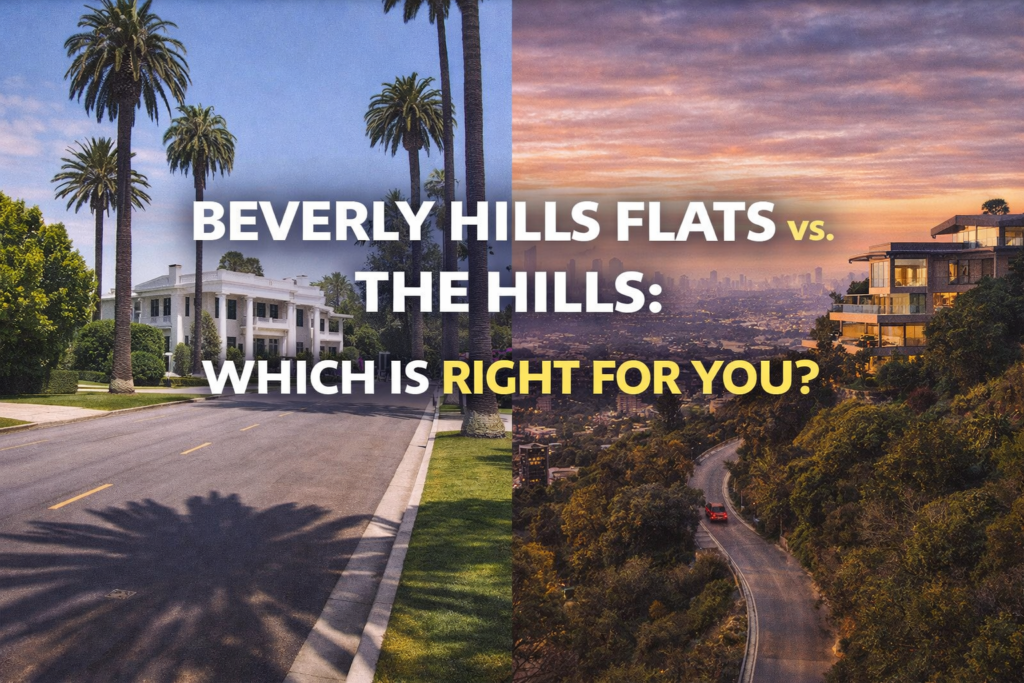
A street-level comparison of Beverly Hills’ two distinct worlds — the walkable, family-friendly Flats south of Santa Monica Boulevard and the private, view-driven hills north of Sunset — and how to decide which one fits your life.
By Jacob Lavian | Los Angeles Real Estate | jacoblavian.com
Every serious Beverly Hills buyer eventually arrives at the same fork in the road. You’ve decided on Beverly Hills — the schools, the zip code, the infrastructure, the cachet. You’ve done your research. You know what your budget looks like. And then you realize that “Beverly Hills” is not one neighborhood — it’s at least two fundamentally different ways of living, separated by elevation and by a lifestyle gap that no amount of money can fully bridge.
The Beverly Hills Flats — the flat, walkable, tree-lined streets south of Santa Monica Boulevard and north of Olympic — and the Beverly Hills Hills — the canyon estates and ridgeline compounds that climb north of Sunset toward Mulholland — are both Beverly Hills in name, both 90210 in zip code, both Beverly Hills Unified in school district. But the experience of living in each is so different that buyers who don’t understand the distinction before they start looking often end up confused, frustrated, and occasionally in the wrong home.
This guide is a street-level comparison of both worlds — written for buyers who are serious about Beverly Hills and want to understand the real tradeoffs before they commit. If you want to talk through which one fits your specific situation, Jacob Lavian knows both parts of Beverly Hills at a granular level and can help you make the right call.
Understanding the Geography First
Beverly Hills is a roughly 5.7 square mile city entirely surrounded by Los Angeles — and it divides naturally into distinct zones that most buyers don’t fully understand until they’ve spent real time here.
The Beverly Hills Flats
The Flats occupy the flat terrain of Beverly Hills south of Santa Monica Boulevard — a roughly grid-like neighborhood of tree-canopied residential streets that runs from Wilshire Boulevard on the south to Santa Monica Boulevard on the north, bounded by Doheny Drive on the east and the city limits near Benedict Canyon on the west. The streets here are wide, straight, and shaded by mature trees — Palm Drive, Maple Drive, Elm Drive, Walden Drive, Linden Drive, Roxbury Drive, Rodeo Drive north of Wilshire — names that carry significant weight in the real estate lexicon of Southern California.
The architecture of the Flats is predominantly traditional — Spanish Colonial, Georgian, Tudor, French Norman, and Mediterranean Revival homes built in the 1920s through 1950s, on generous lots ranging from 7,000 square feet to well over half an acre. The scale is residential but not remote — you are aware of your neighbors in the Flats, in a way that you are not in the hills.
The Hills — North of Sunset
North of Sunset Boulevard, Beverly Hills rises dramatically into the Santa Monica Mountains. The terrain is no longer flat — it’s canyon walls and ridgelines and switchback roads that climb into genuine mountain geography. Trousdale Estates, Benedict Canyon, Coldwater Canyon, and the various private enclaves tucked into the hillsides above Sunset constitute what most people mean when they say “the Beverly Hills hills.”
The streets here are not grids — they’re winding canyon roads and private drives that follow the topography. Loma Vista Drive, Cielo Drive, Schuyler Road, Tower Road, Elden Way, Hillgrove Drive — these are not streets you can understand from a map. You have to drive them, feel how they climb, understand where they go and don’t go, before the geography makes sense.
The Middle Zone — Between Sunset and Santa Monica
There’s a middle band of Beverly Hills — between Santa Monica Boulevard and Sunset Boulevard — that doesn’t fit neatly into either category. Streets like Sunset Boulevard itself, Lexington Road, Elevado Avenue, and Carla Ridge sit at the transition between the flat world below and the hill world above. Some of these properties have slight elevation and partial views; others are essentially flat with slightly larger lots than the Flats proper. This zone is often overlooked by buyers focused on the clear distinction between Flats and Hills — but it contains some genuinely interesting properties.
The Beverly Hills Flats: What It’s Actually Like to Live There
The Streets and the Feel
There is a particular quality to late afternoon light on the Flats streets of Beverly Hills that is hard to describe and impossible to forget. The palm trees that line Palm Drive catch the golden hour at an angle that makes every block look like a painting. The lawns are immaculate. The sidewalks — actual sidewalks, a rarity in much of LA — are wide and shaded and populated by nannies with strollers, elderly residents walking small dogs, and the occasional gardening crew maintaining the kind of landscaping that requires full-time attention.
The Flats feel like a genuine neighborhood in a way that most of LA’s luxury residential areas do not. People know their neighbors. Children ride bikes on the streets on weekend mornings. There are block parties, holiday decorations visible from the street, and the kind of ambient community life that comes from density, walkability, and shared infrastructure. It is not the isolation of the hills — it is the opposite, the Beverly Hills version of living in a real place with real neighbors and real daily life.
Walkability — The Flats’ Greatest Advantage
The single most significant practical advantage of the Beverly Hills Flats over the hills is walkability — and it is a more significant advantage than most buyers from car-dependent parts of LA realize until they’ve lived it.
From a home on Roxbury Drive or Maple Drive or Beverly Drive, you can walk to:
- Beverly Drive commercial corridor: Restaurants, coffee shops, boutiques, dry cleaners, pharmacies — the kind of daily-life infrastructure that makes a neighborhood feel like a place rather than a collection of houses
- Bristol Farms on Little Santa Monica: One of the best grocery stores in Southern California, walkable from most of the northern Flats streets
- Beverly Hills Farmers Market: Sunday mornings on Canon Drive — one of the best farmers markets in LA, right in the heart of the city
- Rodeo Drive and the Golden Triangle: The concentration of luxury retail, restaurants, and hotels that defines Beverly Hills’ public identity
- Beverly Gardens Park: The linear park along Santa Monica Boulevard that runs the entire north edge of the Flats — a genuine green spine through the neighborhood
- Beverly Hills schools: Most of the elementary schools that serve Beverly Hills Unified are in or adjacent to the Flats — El Rodeo, Hawthorne, and Beverly Vista are all walkable or a short drive from most Flats addresses
This walkability is not a minor amenity — it is a fundamentally different relationship with daily life. The family that lives in the Flats and walks to school in the morning, stops at the farmers market on Sunday, and walks to dinner on Beverly Drive on a Thursday evening is living a lifestyle that is simply not available from the hills. And for buyers who have come from cities where this kind of daily life is the norm — New York, Chicago, Boston, San Francisco — the Flats offers something that the hills fundamentally cannot.
The Homes: What the Flats Actually Offers
Flats homes are predominantly two-story traditional architecture on flat, relatively square lots. The lot sizes are generous by most standards — 7,500 to 15,000 square feet is typical, with larger lots on the broader streets — but they are not the sprawling hillside acreage of Trousdale or Benedict Canyon. You have neighbors on both sides. You can, on some streets, see into neighboring properties from upper floors.
What the Flats offers architecturally is extraordinary housing stock with genuine pedigree. The Spanish Colonials on Walden Drive, the Georgians on Roxbury, the French Normandy estates on Linden — these are homes that were built with craft and care and materials that simply aren’t used in new construction. Plaster walls, hardwood floors, original millwork, copper plumbing, and the kind of proportional room-making that the best residential architects of the 1920s–1950s understood intuitively.
The renovation opportunity in the Flats is significant — many of these homes have been lovingly maintained but not modernized, offering buyers the chance to preserve extraordinary architectural bones while updating interiors, systems, and outdoor living to contemporary standards. Done well, a renovated Flats home is among the most beautiful residential properties in Southern California.
Price Range in the Flats
Beverly Hills Flats homes typically trade in a range from approximately $4 million for a smaller or original-condition home to $15 million+ for a fully renovated estate on a large lot. The most desirable streets — Roxbury Drive, Walden Drive, Linden Drive, the northern streets closest to Santa Monica Boulevard — command premiums over comparable properties on less coveted blocks. Price per square foot is typically $1,500–$2,500+ depending on condition, lot size, and street
Who the Flats Is Right For
The Beverly Hills Flats tends to attract:
- Families with children who want walkability to schools, parks, and daily life
- Buyers coming from urban environments who want neighborhood feel within a luxury context
- Those who entertain frequently and want guests to arrive easily without navigating hillside roads
- Buyers who prioritize lot flatness for outdoor living — pool, lawn, children’s play areas
- Buyers who want neighbors and community rather than seclusion and isolation
- Those who value the prestige of specific street addresses within the Flats
The Beverly Hills Hills: What It’s Actually Like to Live There
The Drive In — and What It Tells You
The moment you turn north off Sunset and begin climbing into the Beverly Hills hills, something changes. The city sound drops away. The roads narrow and begin to wind. The vegetation gets denser — mature trees overhang the road, bougainvillea spills over walls, and the properties behind their gates become less visible, not more, as you climb. By the time you reach the upper streets of Trousdale or the private enclaves above Benedict Canyon, you feel genuinely removed from Los Angeles — not insulated from it by privilege, but actually elevated above it, looking down on it from a different world.
This feeling — this sense of genuine separation from the city — is what every hill buyer is paying for, whether they articulate it that way or not. The views are part of it. The quiet is part of it. But the deeper thing is the psychological distance from the density, the traffic, the noise, and the visibility that characterize life at lower elevations. In the hills, you exist on your own terms in a way that the Flats, for all its beauty, cannot fully offer.
The Views
The views from the Beverly Hills hills are, on their best days, among the most extraordinary urban panoramas on earth. From the upper elevations of Trousdale Estates — from the right property on Loma Vista Drive or Tower Road or Cielo Drive — you can see from downtown Los Angeles to the Pacific Ocean, with the entire basin of the city spread below you in a display that is simply not available from any address in the Flats.
The view experience changes throughout the day in ways that Flats buyers rarely appreciate until they’ve spent time in the hills. Morning brings a clarity — before the marine layer burns off, the basin sits below in a soft gray-blue haze that makes the city look like a watercolor. Midday the light is bright and the distances sharp. Sunset, on the right evening, turns the whole western horizon into something that stops conversation. And at night — the full basin of Los Angeles lit up below you, extending in every direction to the horizon — is the view that makes hills buyers understand why they paid what they paid.
Privacy — The Hills’ Greatest Advantage
What the hills offer that the Flats fundamentally cannot is genuine privacy — not the privacy of a gated driveway in a neighborhood where neighbors can still see you, but the privacy of physical separation, elevation, and limited access that comes from living on a winding hillside road where only residents and their guests have reason to be.
In the Beverly Hills hills — particularly in Trousdale Estates with its 24/7 private security, or in the gated enclaves of Benedict Canyon — you can live your life without being observed. You can have guests arrive without spectacle. You can walk from your front door to your car without being photographed. You can have your children play in the yard without worrying about who is watching. For many hill buyers — particularly those with public profiles or high-visibility careers — this privacy is not a luxury. It is a necessity.
The Car Reality — Being Honest About the Tradeoff
Here is where honesty requires departing from the promotional tone that most Beverly Hills real estate content maintains: living in the Beverly Hills hills means living in your car in a way that Flats living does not.
You cannot walk to anything from most hill addresses. The nearest coffee requires a drive. The school run requires a drive. Dinner requires a drive. Groceries require a drive. For buyers coming from walkable urban environments, this transition is more significant than they typically anticipate — and it is one of the most common sources of adjustment friction for new hill residents who fell in love with the views and the privacy without fully internalizing what it means to be car-dependent in daily life.
The practical reality of hillside life: a five-minute drive to Sunset via Doheny, then ten minutes to wherever you’re going on the flats — or via Coldwater Canyon over the hill to the Valley. The connectivity is genuinely good for a hillside address. But it is fundamentally different from walking to Bristol Farms on a Saturday morning with your children, and buyers should be honest with themselves about how much that matters to them before choosing the hills over the Flats.
The Homes: What the Hills Actually Offers
Hill homes vary more dramatically than Flats homes — from the architecturally significant mid-century estates of Trousdale to the canyon compounds of Benedict Canyon to the gated compounds along Mulholland at the northern edge of Beverly Hills. What unites them is lot size, elevation, and the primacy of outdoor living and views over neighborhood walkability and street presence.
Many of the most significant hill homes are essentially inward-facing — designed for the people inside them rather than for the street. The approach may be modest — a gate, a wall, a narrow driveway that gives nothing away — but inside the walls, the property opens up to extraordinary outdoor living spaces, pools positioned for views, terraced gardens, and the kind of horizontal openness that flat lots with neighbors on both sides simply cannot replicate.
Price Range in the Hills
Beverly Hills hill properties trade across a wide range depending on location, views, architecture, and lot size. Entry-level hill properties — smaller lots with partial views, less architecturally significant — can be found in the $4–$7 million range. Mid-range hill estates with good views, well-located lots, and quality architecture typically trade from $8–$15 million. The upper tier — Trousdale Estates, exceptional view properties, architecturally significant estates — ranges from $15 million to well above $30 million for the most significant properties.
Who the Hills Is Right For
The Beverly Hills hills tends to attract:
- Buyers who prioritize views and privacy above all else
- High-profile individuals who need the security and seclusion that hillside living provides
- Buyers comfortable with and accustomed to car-dependent daily life
- Architecture enthusiasts drawn to the mid-century estate heritage of Trousdale
- Those who entertain at home rather than in restaurants — the hills rewards lavish home entertaining
- Buyers who want maximum lot size and outdoor living space
- International buyers who want the most private and prestigious Beverly Hills address available
Head-to-Head: Flats vs. Hills Across Every Category That Matters
Walkability
Flats wins decisively. Walking to school, groceries, restaurants, parks, and daily life is a genuine reality in the Flats. In the hills, you drive everywhere, always. This is not a minor quality-of-life difference — it is a fundamental difference in how you spend your time and move through your day.
Views
Hills wins decisively. The panoramic city and ocean views available from the best hill properties are simply not available from the Flats. Some Flats homes have courtyard gardens, beautiful mature trees, and lovely outdoor spaces — but they do not have the view of Los Angeles at night from 1,000 feet of elevation. If views are your priority, the hills is your answer.
Privacy
Hills wins significantly. The physical separation, limited access, and 24/7 security of Trousdale and similar hill enclaves provides a level of privacy that the Flats cannot match. Even on a quiet Flats street, you have sidewalk pedestrian traffic, visible neighbors, and the ambient exposure of flat-land living. In the hills, that exposure disappears.
School Access
Flats wins slightly. Both Flats and Hills addresses are within Beverly Hills Unified School District — but the schools themselves are in or adjacent to the Flats, making school logistics easier for Flats families. Hill families drive to school regardless. For families who prioritize being part of the school community — volunteering, after-school activities, easy pickup — the Flats is simply more convenient.
Entertaining
Hills wins for home entertaining — Flats wins for restaurant access. The scale and layout of hill homes — with their sprawling outdoor entertaining areas, dramatic views, and seclusion — makes home entertaining exceptional. Flats homes entertain beautifully too, but the intimacy of the lot means gatherings feel more contained. For restaurant entertaining, the Flats’ walkability and proximity to Beverly Drive and the Golden Triangle is a clear advantage.
Architectural Interest
Hills has the edge for mid-century enthusiasts — Flats for traditional architecture lovers. Trousdale’s mid-century estate heritage is unmatched in Southern California. But the Spanish Colonials, Georgians, and French Normandys of the Flats represent a different kind of architectural excellence that is equally significant and arguably more rare in genuinely pristine condition.
Value and Appreciation
Both hold value exceptionally well — but for different reasons. Flats homes are underpinned by scarcity (Beverly Hills has very limited land), school district quality, and consistent demand from families. Hill properties are underpinned by view scarcity, privacy, and the irreplaceable character of Trousdale Estates. Both have historically outperformed the broader LA market over long periods.
Daily Life Friction
Flats wins. This is the honest category that hill enthusiasts sometimes minimize. The daily friction of hillside living — the drives, the winding roads, the occasional fog that makes the descent into Sunset feel genuinely challenging, the delivery drivers who can’t find your address — is real. It’s manageable, and for the right buyer it’s more than worth it. But it exists, and Flats living is genuinely easier in the mechanics of daily life.
How to Actually Decide: The Questions to Ask Yourself
After working with buyers across both parts of Beverly Hills for years, the decision usually comes down to a few honest questions that buyers need to answer about their own lives — not about the real estate market:
How important is walkability to how you actually live?
Not how you imagine living — how you actually live. If you currently walk to get coffee, walk to dinner, walk your children to school, and walk to the farmers market on weekends — and those habits are central to your quality of life — the Flats will make you happier. If you currently drive everywhere and don’t experience that as a loss, the hills’ tradeoff costs you very little.
Do you have children, and what stage are they at?
Families with young children often find the Flats more practical — school logistics, playdates, neighborhood community, and the flat outdoor spaces that kids actually use are all easier in the Flats. Families whose children are older, or buyers without children, often find the hills’ privacy and views more compelling without the practical tradeoffs being as significant.
How much do you entertain, and how?
If your social life is primarily restaurant-based — you go out more than you host — the Flats’ proximity to Beverly Hills dining is genuinely valuable. If you host at home regularly and prefer that your entertaining space be dramatic, private, and visually extraordinary, the hills’ estate living is built for you.
Is privacy a necessity or a preference?
There is a meaningful difference between buyers for whom privacy is a genuine operational requirement — high-profile public figures, executives with security concerns, international buyers who want true seclusion — and buyers for whom privacy is a preference. For the former, the hills is often the only answer. For the latter, the Flats may offer enough privacy at a lifestyle tradeoff that works much better.
What is your honest relationship with driving?
This is the question that buyers most often answer aspirationally rather than honestly. If the idea of driving every time you leave your property sounds fine in the abstract but would frustrate you in daily practice — choose the Flats. If car-dependent living is your norm and you genuinely don’t experience it as a limitation — the hills will serve you beautifully.
Jacob’s Take: I’ve watched buyers talk themselves into the hills because the views are extraordinary and the privacy is real — and then spend the first year wondering why they feel slightly disconnected from daily life. And I’ve watched buyers talk themselves into the Flats because it’s more practical and then discover that the view they gave up matters to them more than they thought. The honest conversation about how you actually live — not how you aspire to live — is the most valuable thing I can offer a Beverly Hills buyer.
Is There a Middle Ground? The Streets Between Sunset and Santa Monica
For buyers who genuinely want elements of both worlds — some walkability, some views, meaningful lot size, and a price point that splits the difference — the zone between Sunset and Santa Monica Boulevard deserves serious consideration.
Streets like Lexington Road, Elevado Avenue, Carmelita Avenue, and the lower reaches of Benedict Canyon Drive sit at the transition between the flat world and the hill world. They offer more elevation than the Flats — occasional partial views, a slightly quieter street environment, and larger lots in some cases — without the full car-dependency of the upper hills. Some of these properties represent genuinely excellent value relative to comparable properties further up the hill or in the prime Flats blocks.
This middle zone is less discussed in Beverly Hills real estate content because it doesn’t fit the clean narrative of “Flats vs. Hills” — but for the right buyer it can be the most interesting part of the Beverly Hills market. An experienced agent who knows these streets intimately is essential to identifying the right properties here.
Frequently Asked Questions: Beverly Hills Flats vs. The Hills
What is the difference between Beverly Hills Flats and Beverly Hills Hills?
The Beverly Hills Flats is the flat, grid-like residential neighborhood south of Santa Monica Boulevard — walkable, family-oriented, and characterized by traditional architecture on generously sized flat lots. The Beverly Hills Hills refers to the hillside neighborhoods north of Sunset Boulevard — including Trousdale Estates, Benedict Canyon, and various private hillside enclaves — characterized by panoramic views, dramatic privacy, winding roads, and mid-century and contemporary estate architecture. Both are within the City of Beverly Hills and the Beverly Hills Unified School District, but the daily experience of living in each is fundamentally different.
Which is more expensive — Beverly Hills Flats or the Hills?
Both command significant prices, but the ranges overlap. Prime Flats addresses on coveted streets like Roxbury Drive and Walden Drive can trade at $10–$15 million and above for exceptional estates. The upper tier of Trousdale Estates and the most significant hill properties trade from $15 million to well above $30 million. Entry-level properties exist in both areas in the $4–$7 million range. The most expensive properties in Beverly Hills overall tend to be in the hills, but the Flats’ best addresses are genuinely competitive.
Is Beverly Hills Flats or the Hills better for families with children?
Most families with young children find the Flats more practical — walkable school access, flat lots for outdoor play, neighborhood community, and easy daily logistics. The hills can work beautifully for families — particularly those with older children or those who are accustomed to car-dependent daily life — but the Flats’ school-adjacent location and walkability is a genuine practical advantage for families with children at Beverly Hills’ elementary schools.
What neighborhoods are in the Beverly Hills Hills?
The Beverly Hills hills encompasses several distinct areas including Trousdale Estates (the most architecturally significant and exclusive enclave, centered on Loma Vista Drive north of Sunset), Benedict Canyon (the winding canyon corridor that runs north toward Mulholland), and various private hillside streets and gated enclaves that sit between Sunset and the northern city limits. Each has its own character, price range, and access profile.
Can you walk anywhere from Beverly Hills Flats?
Yes — and this is one of the Flats’ defining advantages. From most Flats addresses you can walk to Bristol Farms, Beverly Drive restaurants, the Beverly Hills Farmers Market, Beverly Gardens Park, and the Golden Triangle retail corridor. For an LA luxury neighborhood, the Flats offers genuinely exceptional walkability that is essentially unavailable from any hillside Beverly Hills address.
What are the best streets in the Beverly Hills Flats?
The most coveted streets in the Beverly Hills Flats include Roxbury Drive, Walden Drive, Linden Drive, Elm Drive, Maple Drive, and the north-south streets between Santa Monica and Sunset closest to Beverly Drive. Properties on these streets — particularly those with larger lots and well-preserved or beautifully renovated original architecture — command significant premiums and are among the most sought-after residential addresses in Southern California.
What is Trousdale Estates and is it part of Beverly Hills?
Trousdale Estates is an exclusive residential enclave within the City of Beverly Hills, situated north of Sunset Boulevard on the hillside above the city. It is centered on Loma Vista Drive and developed primarily in the 1950s–1960s under strict architectural guidelines requiring single-story construction and design review. It is subject to the Trousdale Ordinance, which protects view corridors and architectural character. It is one of the most significant residential neighborhoods in Los Angeles — combining mid-century architectural heritage, panoramic views, 24/7 private security, and Beverly Hills city services. Jacob Lavian specializes in Trousdale Estates and the broader Beverly Hills hills market.
How do I decide between Beverly Hills Flats and the Hills?
The decision comes down to honest answers about how you actually live — not how you aspire to live. If walkability, school proximity, and neighborhood community are important to your daily life, choose the Flats. If views, privacy, and seclusion are your primary motivations and car-dependent daily life doesn’t bother you, the hills will serve you beautifully. The honest conversation about your daily habits and priorities — not the abstract appeal of views or walkability — is the most important conversation to have before deciding. Jacob Lavian has helped buyers navigate exactly this decision across Beverly Hills for over 12 years.
Trying to decide between the Beverly Hills Flats and the Hills? Contact Jacob Lavian for a free consultation — let’s talk through your priorities and find the right part of Beverly Hills for your life.
jacoblavian.com | Los Angeles Real Estate