A complete guide to Accessory Dwelling Units in LA — what they are, what they cost, what they earn, how the permitting works, and how to decide if building one is right for your property.
By Jacob Lavian | Los Angeles Real Estate | jacoblavian.com
If you own property in Los Angeles, there is a very good chance you are sitting on a value-add opportunity that you haven’t fully explored. California’s ADU legislation — dramatically expanded between 2017 and 2023 — has transformed what’s possible on residential lots across the state, and Los Angeles homeowners have responded: ADU permit applications in LA have increased more than 400% since 2018, making it one of the most significant shifts in residential real estate in the city’s history.
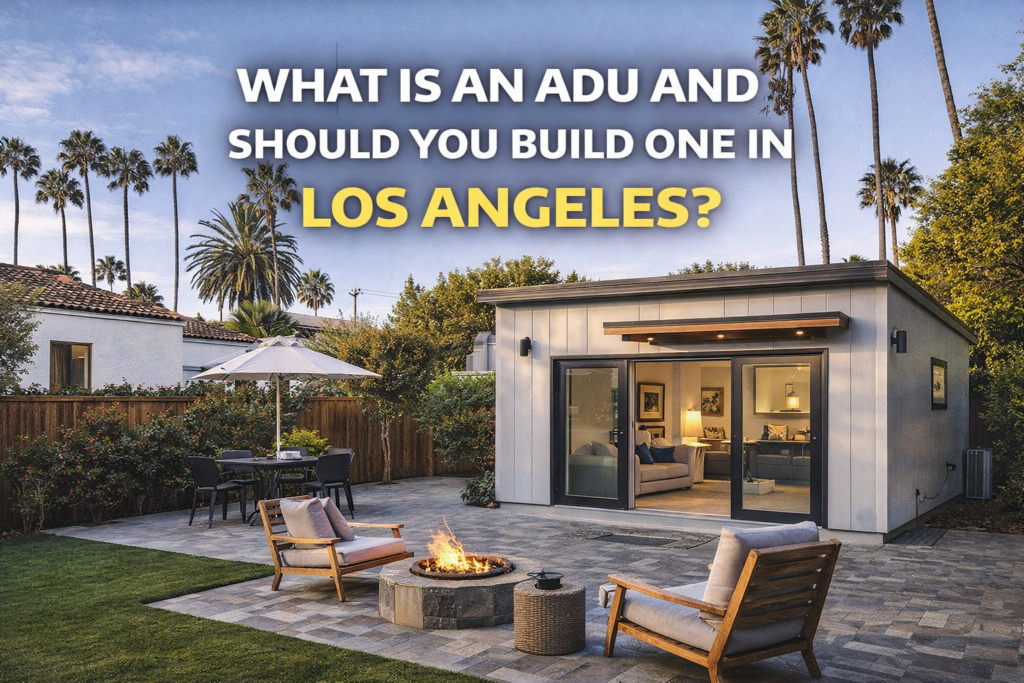
An ADU — Accessory Dwelling Unit — is a secondary residential unit on the same lot as a primary residence. You may know them by other names: granny flat, in-law unit, backyard cottage, casita, garage conversion. Whatever you call them, they represent one of the most compelling financial opportunities available to LA property owners right now — the ability to add rental income, increase property value, and create flexible living space on land you already own.
But ADUs are not right for every property or every owner. The costs are significant, the permitting process has real complexity, and the financial case depends heavily on your specific property, your neighborhood, and your goals. This guide gives you a complete, honest picture of what ADUs are, what they cost, what they earn, how permitting works in LA, and how to decide whether building one makes sense for you. And if you want to talk through your specific property, Jacob Lavian works with both homeowners exploring ADU potential and buyers specifically looking for properties with strong ADU opportunity.
What Exactly Is an ADU?
An Accessory Dwelling Unit is a fully self-contained residential unit — with its own kitchen, bathroom, and sleeping area — located on the same lot as a primary single-family or multifamily residence. The key word is self-contained: an ADU is a complete, independent dwelling, not just a bedroom or a converted living space that shares facilities with the main house.
There are four main types of ADUs in California:
Detached ADU
A freestanding structure separate from the main house — the most desirable type from a tenant’s perspective because it offers complete independence and privacy. A detached ADU can be a converted garage, a new construction in the backyard, or a converted pool house or workshop. Maximum size in LA is typically 1,200 square feet for a detached ADU, though zoning and lot size affect the specific limits.
Attached ADU
An addition physically attached to the main house but with its own entrance and self-contained facilities. An attached ADU might be an addition to the side or rear of the house, a converted attached garage, or a second unit built above a garage addition. Same 1,200 square foot maximum in most LA configurations.
Junior ADU (JADU)
A smaller unit created within the existing footprint of the main house — typically by converting a bedroom, enclosed porch, or attached garage space into a self-contained unit. JADUs are capped at 500 square feet and require a separate entrance but can share a bathroom with the main house under certain conditions. They are the lowest-cost ADU option because they require no new construction — just reconfiguration of existing space.
Garage Conversion ADU
Converting an existing garage — attached or detached — into a living unit. Garage conversions are the most common and typically most cost-effective ADU type in LA because the structure already exists, reducing the cost dramatically compared to new construction. California law specifically protects the right to convert a garage to an ADU regardless of local parking replacement requirements — one of the most powerful provisions of the state ADU legislation.
Important distinction: An ADU is not a room rental, a short-term rental, or an informal arrangement. It is a permitted, legally constructed secondary dwelling unit that meets all building codes and has a Certificate of Occupancy. Unpermitted secondary units — common throughout LA’s older housing stock — are fundamentally different from a permitted ADU and carry significant legal and financial risk.
What Changed: California’s ADU Law Revolution
To understand why ADUs have become so significant in LA, you need to understand what changed legally. Prior to 2017, ADUs — then called “second units” or “granny flats” — were technically permitted in most California cities but subject to local restrictions that made them practically impossible to build in many areas. Minimum lot sizes, parking replacement requirements, owner-occupancy mandates, design review processes, and utility connection fees effectively killed most ADU projects before they started.
Between 2017 and 2023, the California legislature passed a series of bills that systematically eliminated most of the local restrictions that prevented ADU construction:
- Parking replacement eliminated: When you convert a garage to an ADU, you no longer have to replace the lost parking spaces. This single change unlocked garage conversion across LA.
- Owner-occupancy requirement removed: You no longer have to live on the property to build or rent an ADU. Investment property owners can build ADUs on rental properties.
- Minimum lot size restrictions eliminated: Most minimum lot size requirements for ADUs have been preempted by state law. Even small lots can now support an ADU in most cases.
- Setback reductions: ADUs can be built as close as 4 feet to rear and side property lines in most cases — dramatically expanding buildable area on smaller lots.
- Impact fees eliminated for small ADUs: ADUs under 750 square feet are exempt from most city impact fees — reducing soft costs significantly.
- Multiple ADUs per lot: In many configurations, property owners can now build more than one ADU — a detached ADU plus a JADU, for example, on the same lot.
- Streamlined permitting: Local jurisdictions are required to process ADU permits within 60 days and cannot impose design standards that are inconsistent with state law.
The cumulative effect of these changes has been transformative. Properties that could not legally add a second unit five years ago can now add one — or sometimes two — under state law. The ADU opportunity across LA is genuinely new, and many property owners have not yet fully understood or acted on it.
The Financial Case: What ADUs Cost and What They Earn
The financial analysis is where the ADU decision gets real. The numbers vary significantly based on ADU type, property location, and finish level — but here is a realistic picture of what you’re actually looking at in the Los Angeles market.
ADU Construction Costs in LA
Los Angeles is an expensive construction market. Labor costs, permit fees, material costs, and the complexity of working in older housing stock all push ADU construction costs meaningfully higher than national averages.
Realistic cost ranges for different ADU types in LA:
- JADU (Junior ADU — within existing footprint): $40,000–$120,000. The lowest-cost option because no new square footage is being added — just reconfiguration, kitchen installation, separate entrance, and finishes.
- Garage conversion ADU: $80,000–$200,000. Widely variable depending on the garage’s existing condition, size, foundation type, and how much work is needed to bring it to habitable standards.
- Attached ADU addition: $150,000–$300,000. Requires new construction attached to the existing structure — foundation, framing, all systems — plus integration with the existing building.
- Detached ADU — new construction: $180,000–$400,000+. The highest cost option, requiring complete new construction from foundation to roof. Size, finishes, and site conditions drive the range significantly.
- Prefabricated/modular ADU: $150,000–$280,000 all-in. Factory-built units installed on a prepared foundation — faster than site-built construction and increasingly popular in LA. Quality varies significantly by manufacturer.
These ranges assume standard residential finishes. High-end finishes, challenging site conditions (hillside, limited access, expansive soil), or complex permitting situations can push costs significantly higher. Always add 15–20% contingency to any ADU budget — unforeseen conditions are the rule, not the exception, in LA construction.
Soft Costs — What Most Estimates Leave Out
Beyond construction, budget for:
- Architect and design fees: $10,000–$30,000 for plans and construction documents
- Permit fees: $5,000–$20,000+ depending on ADU size and LA jurisdiction (City of LA, Beverly Hills, Santa Monica, etc. all have different fee structures)
- Engineering: $3,000–$10,000 for structural engineering if required
- Utility connections: New electrical panel, gas line, water and sewer connections can add $10,000–$40,000+ depending on existing infrastructure
- Site preparation: Demolition of existing structure, grading, drainage — $5,000–$30,000 depending on site
- Landscaping restoration: Construction disrupts existing landscaping — budget to restore
A realistic all-in budget for a well-executed detached ADU in LA — including construction, soft costs, and contingency — typically runs $250,000–$450,000. Garage conversions typically run $100,000–$250,000 all-in. These numbers are real — not the optimistic contractor estimates that many ADU guides publish.
What an ADU Earns in Los Angeles
The rental income from an ADU varies dramatically by neighborhood, ADU size, and quality. Here are realistic market rent ranges for well-executed ADUs across different LA neighborhoods:
- Eagle Rock, Glassell Park, Atwater Village: $1,800–$2,800/month for a 400–700 sq ft ADU
- Silver Lake, Los Feliz, Echo Park: $2,200–$3,200/month
- Culver City, West Adams, Palms: $2,000–$3,000/month
- Santa Monica, Venice, Marina del Rey: $2,500–$4,000/month
- Sherman Oaks, Studio City, Encino: $1,800–$2,800/month
- Beverly Hills, Brentwood, Pacific Palisades: $3,000–$5,000+/month
At $2,500/month in rental income, an ADU generates $30,000 per year in gross income. After vacancy allowance, management fees, maintenance, and property tax increase, net annual income is typically $22,000–$26,000. At a cost of $300,000 to build, that represents a 7–9% cash-on-cash return on the construction cost — strong by any measure, and in an asset (real property) that also appreciates over time.
The Property Value Impact
Beyond rental income, a permitted ADU directly increases your property’s market value. The value added depends on the ADU’s income, size, quality, and the valuation methodology buyers and appraisers apply — but general rules of thumb suggest:
- A well-executed ADU generating $2,500/month in rent adds $150,000–$300,000 in property value in most LA neighborhoods
- In premium neighborhoods where rental rates are higher, the value add is proportionally greater
- A permitted ADU adds value even if it’s currently occupied by family rather than a paying tenant — the income potential is what drives valuation
- Unpermitted ADUs add far less value and create disclosure and lender complications — permitted status is critical
The combined effect of rental income and property value appreciation makes the ADU one of the highest-return investments available to LA homeowners — when the property, location, and execution align.
Example: You spend $280,000 building a detached ADU on your Eagle Rock property. It rents for $2,400/month, generating $24,000/year in net income after expenses. It adds $220,000 to your property’s appraised value. Your total return on the $280,000 investment: $24,000/year income plus $220,000 in immediate equity — a combined first-year return of approximately 87% on invested capital, before any future appreciation. This is why serious investors pay close attention to ADU potential when evaluating properties.
The LA Permitting Process: What You’re Actually Getting Into
The permitting process for an ADU in Los Angeles is more manageable than it was five years ago — but it is still a real process with real timelines and real complexity. Understanding what you’re getting into before you start is essential to managing your expectations and your budget.
Step 1: Pre-Application Research
Before you engage an architect or file anything, verify:
- Your property’s zoning designation — most single-family and multifamily zones in LA allow ADUs
- Whether your property is in a historic preservation overlay zone (HPOZ) — these have additional design review requirements
- Your lot size and existing building footprint — these determine what ADU size and type is feasible
- Existing easements, deed restrictions, or CC&Rs that might affect ADU placement
- Which jurisdiction governs your property — City of LA, Beverly Hills, Santa Monica, Culver City, etc. — each has slightly different rules
Step 2: Design and Plans
Hire an architect or ADU design specialist to prepare construction drawings. Good plans are the foundation of a smooth permit process — incomplete or incorrect plans are the most common cause of permit delays and revision cycles. Your designer should be experienced with LA’s specific ADU requirements and familiar with the plan check process.
Many ADU companies now offer pre-approved plan sets — standardized designs that have already been approved by the City of LA, dramatically shortening the plan check timeline. If your property can accommodate a pre-approved plan, this route can cut months off the permitting process.
Step 3: Plan Check and Permit Issuance
Submit your plans to the LA Department of Building and Safety (LADBS) for plan check. California law requires ADU permits to be processed within 60 days — but in practice, the timeline varies. Over-the-counter permits for simple ADUs can sometimes be issued same-day. Complex projects with multiple correction cycles can take 3–6 months. A permit expediter can significantly reduce timelines for complex projects.
Step 4: Construction
Once permits are issued, construction begins. Construction timelines in LA typically run:
- Garage conversion: 3–6 months
- Attached addition: 5–9 months
- New detached construction: 6–12 months
- Prefabricated/modular: 3–5 months from permit issuance
Contractor availability, permit inspection scheduling, and material supply chains all affect actual timelines. Plan for longer than your contractor’s initial estimate — construction timelines in LA routinely exceed initial projections.
Step 5: Inspections and Certificate of Occupancy
Throughout construction, LADBS inspectors verify that work complies with approved plans and building codes. Final inspection and Certificate of Occupancy (C of O) issuance is the last step — and the most important. You cannot legally rent an ADU until it has a C of O. Do not rent an ADU before the C of O is issued — the liability exposure and legal risk is significant.
Is Building an ADU Right for Your Property?
Not every property is a strong ADU candidate — and understanding what makes a property well-suited for ADU development helps you evaluate the opportunity honestly before committing significant capital.
Strong ADU Candidates
- Properties with an existing detached garage: The conversion opportunity is the most cost-effective ADU path available — structure already exists, foundation already exists, utility connections are nearby.
- Lots with meaningful rear yard space: A rear yard of 1,500+ square feet typically provides enough room for a freestanding ADU with required setbacks and outdoor space.
- Properties in high-rent neighborhoods: The rental income justification is strongest where market rents support $2,000+ per month — covering construction costs more quickly and generating stronger cash-on-cash returns.
- Properties with simple site conditions: Flat lots with good access for construction equipment, standard soil conditions, and existing utility infrastructure reduce construction costs and risk significantly.
- Older homes with underutilized attached garage space: Many LA homes have attached two-car garages that are used for storage rather than vehicles — prime conversion candidates.
Challenging ADU Situations
- Hillside properties with access constraints: Construction on hillside lots is significantly more expensive and complex — crane access, soil engineering, retaining walls, and drainage all add cost.
- Properties in HPOZs (Historic Preservation Overlay Zones): Design review requirements add time and cost and may constrain ADU design in ways that affect feasibility.
- Very small lots under 4,000 square feet: While state law allows ADUs on small lots, the practical buildable area after setbacks may be very limited.
- Properties with significant existing coverage: If the main house and existing structures already cover most of the lot, adding an ADU may not be feasible within coverage limits.
- HOA-governed properties: While California law limits HOAs’ ability to prohibit ADUs, some CC&Rs still impose design and aesthetic restrictions that complicate the process.
The Buy-With-ADU-Potential Strategy
One of the strongest investment strategies in today’s LA market is specifically buying properties with strong ADU potential — then building the ADU to dramatically increase both rental income and property value. Buyers who understand ADU potential can identify properties that appear to be overpriced at face value but are actually underpriced relative to their post-ADU income and value.
This requires knowing what to look for: lot configuration, existing structures, zoning, and neighborhood rental rates. Jacob Lavian evaluates ADU potential as part of the investment analysis on every relevant property — identifying opportunities that buyers without this knowledge consistently miss.
ADU vs. Other Investment Strategies: How It Compares
ADU vs. Buying a Separate Rental Property
Building an ADU uses capital you deploy on land you already own — no new property acquisition costs, no new mortgage, no new property taxes on a separate parcel. The return on the construction investment is typically higher than buying a separate rental property in LA at current prices and interest rates. The tradeoff: you’re adding a tenant relationship to your primary residence situation, which some homeowners find uncomfortable.
ADU vs. Whole-Home Renovation
A whole-home renovation improves your quality of life but doesn’t generate income. An ADU generates income that compounds over time and adds value that a kitchen remodel cannot replicate. For owners weighing renovation dollars, an ADU often provides a better financial return than investing the same capital in upgrading the main house.
ADU vs. Short-Term Rental (Airbnb)
The City of LA restricts short-term rentals to primary residences — and even for primary residence STRs, permits are required and strictly enforced. An ADU cannot legally be operated as a short-term rental unless it is your primary residence and you follow all applicable STR regulations. Long-term rental income is the appropriate financial model for most LA ADUs.
Frequently Asked Questions: ADUs in Los Angeles
What does ADU stand for?
ADU stands for Accessory Dwelling Unit — a fully self-contained residential unit located on the same lot as a primary residence. Also commonly known as a granny flat, in-law unit, backyard cottage, casita, or secondary unit.
How much does it cost to build an ADU in Los Angeles?
All-in costs in LA typically range from $100,000–$150,000 for a basic garage conversion to $250,000–$450,000 for a new detached ADU, including construction, design, permits, and contingency. Costs vary based on ADU type, size, site conditions, and finish level. Always get multiple contractor bids and budget 15–20% contingency beyond the base estimate.
How long does it take to build an ADU in Los Angeles?
From project kickoff to Certificate of Occupancy, most LA ADU projects take 9–18 months — including design (1–3 months), permitting (1–4 months), and construction (3–12 months). Prefabricated ADUs can compress this timeline. Complex sites, HPOZ properties, or permitting challenges can extend it significantly.
Do I need a permit to build an ADU in Los Angeles?
Yes — absolutely. An unpermitted ADU is an illegal unit that cannot legally be rented, creates disclosure obligations when you sell, may need to be removed, and carries significant liability exposure. California law has made the permitting process significantly more accessible — the right response to permitting complexity is to work with experienced designers and permit expediters, not to skip permits entirely.
Can I build an ADU on any property in Los Angeles?
Most single-family and multifamily properties in Los Angeles can support at least one ADU under current state law. Lot size, zoning, existing coverage, and site conditions determine what type and size of ADU is feasible. The best way to understand your specific property’s ADU potential is to consult with an ADU designer or architect who can review your lot and existing structures.
Can I rent out my ADU in Los Angeles?
Yes — long-term rental of a permitted ADU is legal and does not require you to live on the property. Short-term rental (Airbnb/VRBO) of an ADU is generally not permitted in LA unless the ADU is your primary residence and you comply with all applicable short-term rental regulations. Standard long-term rental — minimum 30 days — is the appropriate model for most LA ADUs.
Does building an ADU increase my property taxes?
In California, building an ADU triggers a partial reassessment — only the value of the new ADU construction is added to your assessed value, not the entire property. Your existing home’s assessed value under Proposition 13 is not affected. The property tax increase is typically $1,500–$4,000 per year depending on construction cost and local tax rate — a modest cost relative to the rental income generated.
Can I build more than one ADU on my property in Los Angeles?
In many configurations, yes. California law allows one ADU plus one Junior ADU on most single-family lots. Multifamily properties may be able to add more. The specific combination depends on your lot, zoning, and existing structures. An ADU specialist or architect can advise on the maximum ADU configuration for your specific property.
Should I build an ADU before or after selling my home?
In most cases, building an ADU before selling produces better financial outcomes — the completed income-producing unit justifies a higher asking price and attracts a broader buyer pool including investors. Building an ADU specifically for sale purposes works best when the all-in cost is meaningfully less than the value it adds. Jacob Lavian can help you evaluate whether building before listing makes financial sense for your specific property.
Want to know if your LA property is a strong ADU candidate? Contact Jacob Lavian for a free consultation — let’s evaluate your property’s ADU potential and what it could mean for your income and equity.
jacoblavian.com | Los Angeles Real Estate