Celebrity real estate always gets attention, but sometimes the most interesting part of a famous home is not who owned it. It is what the pricing history says about the market.
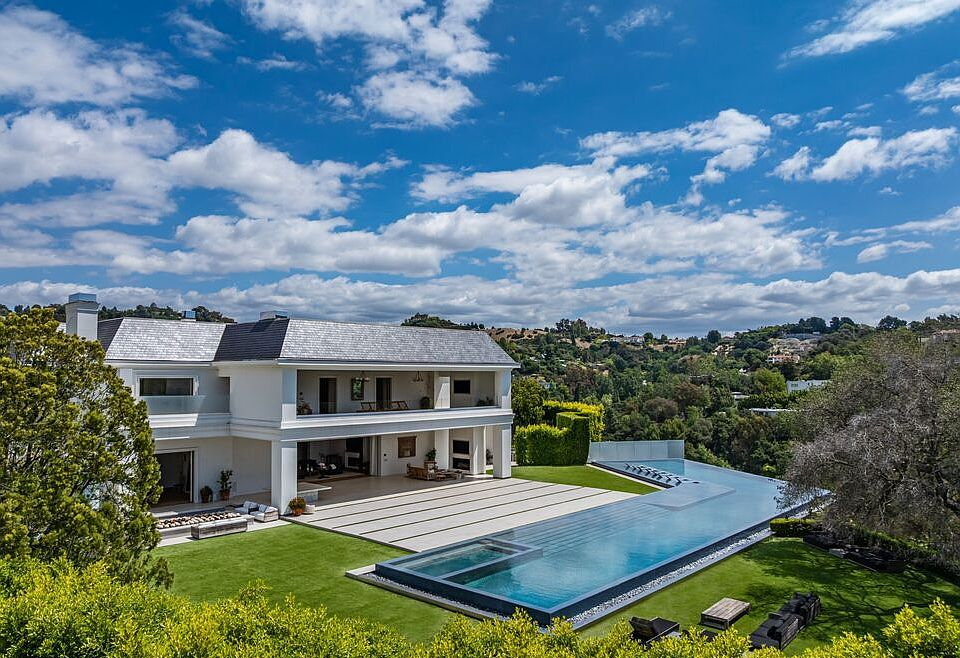
The Beverly Hills-area estate reportedly owned by Jennifer Lopez and Ben Affleck, located at 2571 Wallingford Drive in Beverly Hills , has become a useful case study for home sellers in Los Angeles. According to public reporting and listing history, the couple purchased the property in 2023 for about $60.85 million. The home was later listed for $68 million, reduced multiple times, removed from the market, and then relisted in 2026 for just under $50 million.
That is not just celebrity gossip. That is a pricing lesson.
Even a massive estate with celebrity ownership, privacy, amenities, and name recognition still has to meet the market. A seller can ask any number they want, but buyers decide what a property is worth. That is true for a $50 million Beverly Hills compound, and it is also true for a $1.5 million home, condo, or townhome anywhere in Los Angeles.
If you are thinking about selling real estate in Los Angeles , this listing shows why pricing strategy matters from day one.
The Property: 2571 Wallingford Drive in Beverly Hills
The property discussed in this article is located at 2571 Wallingford Drive, Beverly Hills, CA 90210 . This is the Beverly Hills-area estate widely reported as the former marital home of Jennifer Lopez and Ben Affleck.
Public reports describe the property as a roughly 38,000-square-foot estate on more than five acres, with 12 bedrooms, 24 bathrooms, a large guest house, caretaker house, guard house, gym, boxing ring, sports lounge, bar, basketball and pickleball courts, and garage parking for multiple vehicles.
In other words, this is not a normal luxury home. It is a private compound built for an ultra-high-net-worth buyer.
But that is also part of the challenge. The more expensive and specific a property is, the smaller the buyer pool becomes. A property like this does not just need a wealthy buyer. It needs the right wealthy buyer who wants the location, size, layout, privacy, amenities, and price all at the same time.
That is why ultra-luxury homes can sit longer than sellers expect. The property can be beautiful, rare, and impressive, but if the asking price is ahead of the market, buyers may wait.
The Pricing History Tells the Real Story
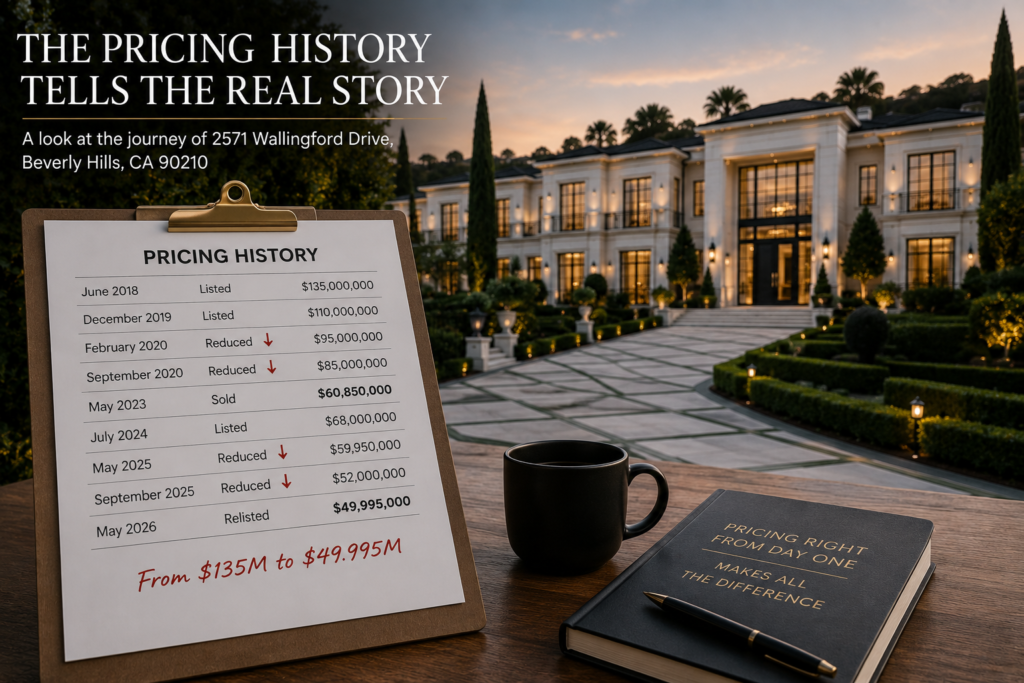
The pricing history is what makes this property so useful for sellers to study. Based on the publicly available listing history, the estate has gone through years of pricing adjustments, removals, relistings, and reductions.
Pricing History Highlights
- June 2018: Listed for $135,000,000
- December 2019: Listed for $110,000,000
- February 2020: Reduced to $95,000,000
- September 2020: Reduced to $85,000,000
- May 2023: Sold for $60,850,000
- July 2024: Listed for $68,000,000
- May 2025: Reduced to $59,950,000
- September 2025: Listed for $52,000,000
- May 2026: Relisted for $49,995,000
That is a major shift. The property was once marketed at $135 million. It later sold for about $60.85 million. Then, after the celebrity ownership period, it came back to market at $68 million before eventually being reduced to just under $50 million.
This is the kind of pricing history sellers should pay attention to. It shows that asking price and market value are not always the same thing.
Why the $68 Million Asking Price Did Not Stick
When the home came back on the market at $68 million, the price may have seemed logical from the seller’s perspective. The property had celebrity ownership, a huge amount of square footage, privacy, land, and luxury amenities. If it was purchased for about $60.85 million, asking $68 million may have looked like a reasonable attempt to recover costs, improvements, commissions, closing costs, and taxes.
But the market does not price homes based on what a seller wants to recover.
Buyers look at comparable sales, current alternatives, condition, location, days on market, renovation quality, carrying costs, taxes, and whether they feel they are getting value. In the ultra-luxury market, buyers also know they may have leverage when a property has been publicly listed, reduced, removed, and relisted.
Once a home becomes known as a listing that has not sold, the psychology changes. Buyers may start asking themselves:
- Why has it not sold yet?
- Was the original price too high?
- Is there something wrong with the property?
- Will the seller reduce it again?
- Can I negotiate harder?
This is why pricing correctly from the beginning matters. A high starting price can sometimes work in a rising market with low inventory. But if buyers reject the price, the listing can lose momentum.
For regular homeowners, this is the same issue on a smaller scale. A home listed too high in Sherman Oaks, Beverly Hills, Studio City, Brentwood, Encino, West Hollywood, or anywhere else in Los Angeles can sit for the same basic reason: buyers do not believe the price is justified.
What Nearby Luxury Sales Suggest
To understand whether the current asking price for 2571 Wallingford Drive is realistic, it helps to look at nearby high-end sales in the Beverly Hills and Beverly Park luxury market.
The current asking price of $49,995,000 works out to roughly $1,316 per square foot, based on the reported 38,000-square-foot size. That is much lower than where the property was previously marketed and lower than some nearby ultra-luxury sales on a price-per-square-foot basis.
Nearby Comp Example: 71 Beverly Park
One nearby high-end sale was 71 Beverly Park , which sold for $63.1 million in June 2025. Based on public listing data, this sale shows that buyers are still willing to pay major prices for the right Beverly Park estate, but only when the property, location, condition, privacy, and pricing align.
Nearby Comp Example: 72 Beverly Park
Another nearby example is 72 Beverly Park , which sold for $35 million in October 2024. This sale helps show the range in the ultra-luxury market, where square footage, lot size, architecture, privacy, condition, and buyer demand can create major differences in final value.
Compared with those nearby sales, the current asking price for 2571 Wallingford Drive appears much more realistic than the prior $68 million asking price. The home may still be a trophy property, but its repeated price reductions show that even the luxury market has limits.
So What Could the Home Actually Be Worth?
Based on the public pricing history, the current asking price, nearby luxury sales, and the fact that the property has already been exposed to the market multiple times, a realistic value range appears to be somewhere around:
$47 million to $52 million
If the seller wants a clean sale and the market remains selective, a final closing price somewhere in the mid-to-high $40 millions would not be surprising.
That does not mean the home is not impressive. It means the market may already be telling us where the real demand is.
The current list price near $50 million may be a serious attempt to reset the conversation and bring buyers back. Instead of trying to force the market to accept a higher number, the seller appears to be moving closer to where buyers may actually engage.
The Measure ULA Problem
There is another major issue for luxury sellers in the City of Los Angeles: Measure ULA.
For properties above the higher threshold, Measure ULA can add a 5.5% transfer tax. At a $49,995,000 sale price, that 5.5% tax alone would be approximately:
$2,749,725
That is before commissions, closing costs, possible concessions, and any other seller expenses.
This is one of the reasons Los Angeles luxury sellers have to focus on net proceeds, not just the headline sale price. A seller might see a $50 million sale and think that is the number that matters, but what actually matters is what remains after taxes, fees, commissions, credits, and other closing costs.
This issue does not only affect celebrity sellers. It can affect any high-value Los Angeles homeowner. If you are preparing to sell a major home, estate, condo, or townhome, understanding your likely net proceeds before listing is critical.
What Regular Sellers Can Learn From This
Most sellers are not selling a 38,000-square-foot celebrity compound. But the lesson is still the same.
A property is worth what the market is willing to pay, not what the seller wants, needs, spent, or hopes to recover.
That can be difficult to accept because sellers usually have emotional and financial reasons for their price. They remember what they paid. They remember what they improved. They know what they need for the next purchase. They compare their home to a neighbor’s sale and assume they should get more.
But buyers do not care about the seller’s backstory. Buyers care about value.
This is why working with the right Los Angeles real estate services matters. A seller needs someone who can look at the property honestly, compare it to the market, identify likely buyer objections, and build a pricing strategy that protects the seller’s leverage.
Overpricing Can Increase Days on Market
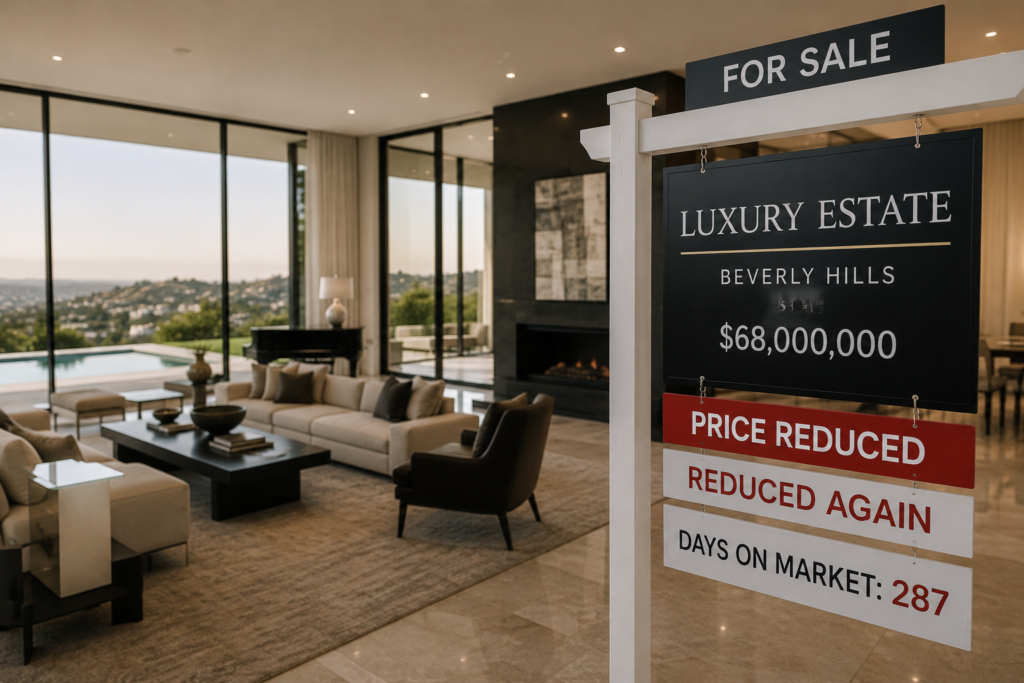
Days on market can become a problem quickly.
When a listing is new, buyers are curious. Agents send it to clients. Serious buyers want to see it. If the property is priced correctly, that first wave of attention can create momentum.
But if the property is overpriced, buyers may ignore it. They may watch from the sidelines. They may wait for a price reduction. Once the listing sits, the seller may have to reduce the price just to bring people back.
This creates a weaker negotiating position. A buyer looking at a stale listing may assume the seller is more flexible, especially if there have already been price reductions.
That is why the first price is so important.
A seller should not underprice blindly, but they also should not list at a number that the market is unlikely to support. The goal is to create demand, not just test an inflated price.
Celebrity Ownership Does Not Guarantee a Premium
Some sellers believe a famous owner automatically makes a property more valuable. Sometimes it can help with attention. It can create press. It can make the listing more memorable.
But attention is not the same as a buyer.
Celebrity ownership may get people to click on the listing, but it does not guarantee that someone will write a $50 million offer. At the end of the day, the buyer still has to want the property, the location, the layout, the amenities, and the price.
In some cases, celebrity ownership can even complicate the sale. The property may attract media attention, curiosity, and public discussion, but the actual buyer pool remains extremely small.
For regular sellers, the lesson is simple: marketing helps, but pricing still has to make sense.
Condition Still Matters, Even at the High End
At any price point, buyers look for reasons to negotiate.
In the ultra-luxury market, buyers may be more focused on privacy, design, land, security, views, architecture, and amenities. But condition still matters. A wealthy buyer may have the money to renovate, but that does not mean they want to overpay for a property that needs work.
For everyday sellers, this is even more important. Before listing, sellers should think about the issues that could hurt the sale later:
- Should the interior be painted?
- Does the roof need inspection?
- Are there sewer or drainage issues?
- Are there signs of water intrusion?
- Is the pool leaking?
- Are there electrical or plumbing problems?
- Should the property be staged?
- Are there repairs that should be handled before escrow?
These items matter because buyers often ask for credits after inspections. Sometimes the credit request is much higher than the actual cost of repair. A seller who prepares early may have more control than a seller who waits for the buyer to discover the problems.
Staging Can Help, But It Is Not Always the Answer
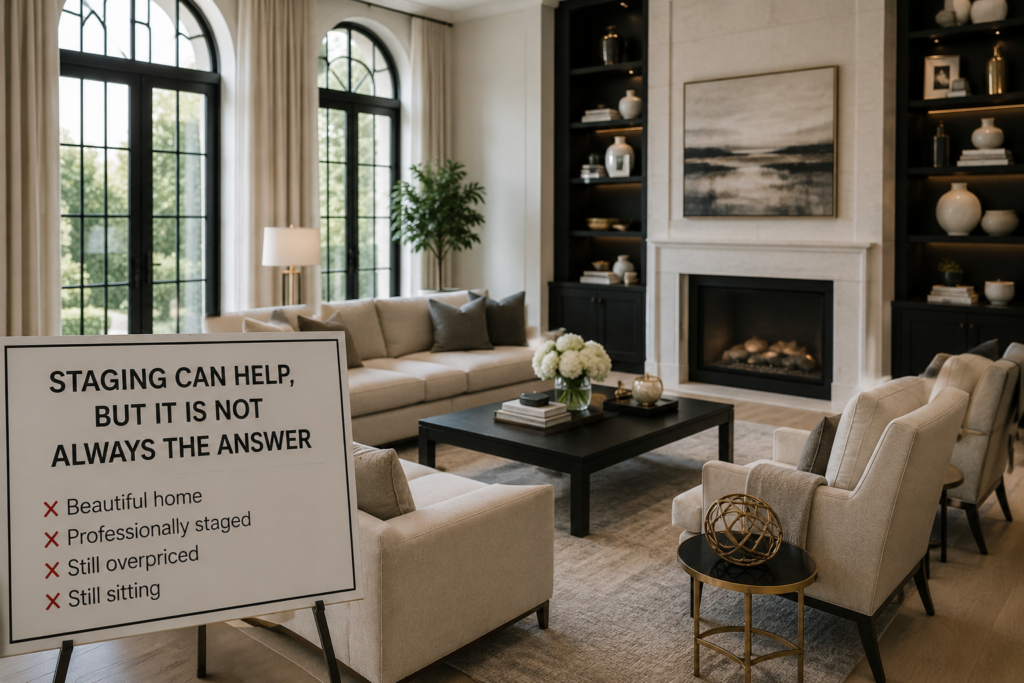
Staging is another issue sellers often misunderstand.
A vacant home can feel cold. A poorly furnished home can feel smaller than it is. A dated home can sometimes benefit from staging because the furniture helps buyers focus on the lifestyle instead of the flaws.
But staging does not fix an unrealistic price. It does not fix a bad floor plan. It does not fix major deferred maintenance. It can help create emotional connection, but it cannot force buyers to overpay.
For Los Angeles sellers, the decision should be strategic. Some homes need full staging. Some only need partial staging. Some need decluttering, paint, cleaning, lighting, and better photography more than they need expensive furniture.
I wrote more about this in my guide on whether you should stage your home before selling in Los Angeles .
Why Sellers Need a Real Pricing Strategy
A real pricing strategy is not just picking the highest number and hoping someone shows up.
A strong pricing strategy should consider:
- Recent comparable sales
- Active competition
- Pending sales, when available
- Property condition
- Buyer demand
- Interest rates and financing conditions
- Days on market trends
- Seller timing
- Possible repair credits
- Transfer taxes and closing costs
This is where experience matters. Pricing is not just math. It is market psychology.
A good agent should know when to push, when to hold firm, when to adjust, and when a seller is at risk of missing the market.
If you are selling in Los Angeles, you need someone who understands both the numbers and the negotiation strategy. You can learn more about my background as an experienced Los Angeles real estate advisor and how I help property owners evaluate the market before listing.
The Bigger Lesson for Los Angeles Homeowners
The Jennifer Lopez and Ben Affleck mansion is an extreme example, but the seller lesson is very practical.
If a famous 38,000-square-foot estate can struggle to find the right buyer at the wrong price, then regular sellers should take pricing seriously too.
Overpricing can lead to longer days on market. Longer days on market can lead to buyer hesitation. Buyer hesitation can lead to price reductions. Price reductions can lead to weaker negotiation leverage.
The better approach is to prepare properly, price intelligently, market aggressively, and negotiate from a position of strength.
For Homeowners
Make sure your property presents well, photographs well, and is priced against the real competition.
For Condo and Townhome Sellers
Understand how HOA dues, reserves, assessments, amenities, parking, building condition, and buyer demand can affect your sale.
Whether you are selling a home, condo, or townhome, the goal is the same: reduce uncertainty and make the buyer feel confident enough to write a strong offer.
What This Home May Ultimately Sell For
My opinion is that the current asking price near $50 million is much closer to reality than the previous $68 million asking price.
Based on the public pricing history and nearby high-end sales, a realistic range may be around $47 million to $52 million, depending on buyer interest, timing, condition, and negotiation. If the seller is motivated and the market remains selective, a closing price in the mid-to-high $40 millions would not be shocking.
The final number will depend on whether the current price creates urgency or whether buyers still believe there is room for another discount.
That is the important lesson: once a property has been reduced multiple times, buyers often wonder if the next reduction is coming.
What Sellers Should Take Away
This listing is not just a celebrity real estate story. It is a reminder that the market is stronger than the seller’s expectations.
A property can be famous, private, massive, and filled with amenities, but if buyers do not accept the price, it will sit.
For Los Angeles sellers, the lesson is clear:
- Do not assume your property is worth more just because it is special to you.
- Do not ignore days on market.
- Do not rely on marketing alone to fix an aggressive price.
- Do not wait until escrow to think about buyer objections.
- Do not focus only on the sale price; focus on net proceeds.
- Do price based on real market evidence.
- Do prepare the property before listing.
- Do work with someone who can protect your leverage from the start.
If you are thinking about selling property in Los Angeles, the right pricing and preparation strategy can make a major difference. Before you list, it is worth understanding what buyers will compare your property to, what objections may come up, and how to position your property to attract serious offers.
To discuss your property and the best way to prepare it for market, visit JacobLavian.com or review my Los Angeles property selling services .
Note: Pricing opinions in this article are based on publicly available listing history, public reporting, and nearby comparable sales. Actual market value can change based on condition, buyer demand, property-specific details, negotiations, and the market at the time of sale.