By Jacob Lavian | Los Angeles Real Estate
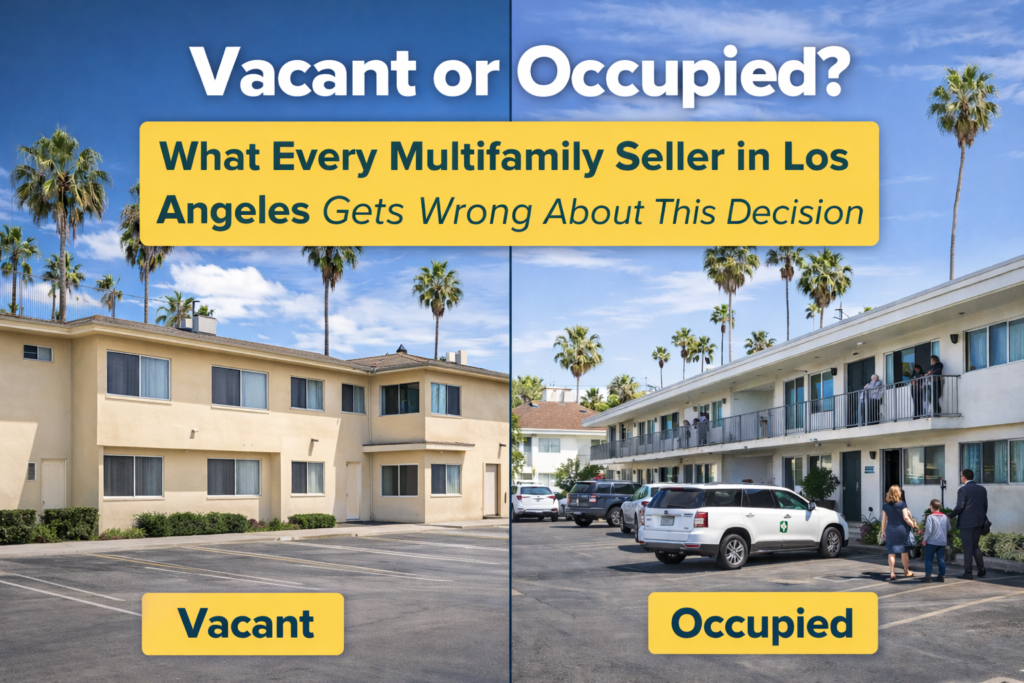
If you own a multifamily building in Los Angeles and you are thinking about selling, one of the first strategic questions is whether you should fill vacant units before going to market or list the property with some units empty. It sounds simple. Most owners assume a full building must always be easier to sell because more occupancy means more rent, more stability, and a cleaner financial presentation. That logic makes sense on the surface. In practice, it is not always how real multifamily buyers think, and it is not always how the best sale is achieved in Los Angeles.
The right answer depends on the actual building, the condition of the vacant units, the type of buyer most likely to make an offer, the way the rent roll is presented, and how the sale process is managed without creating unnecessary disruption inside the property. In many Los Angeles multifamily sales, some vacancy is not a fatal flaw at all. Sometimes it is a clear advantage. Sometimes it creates leverage. Sometimes it attracts a more aggressive buyer pool. And sometimes, if it is handled poorly, it becomes a reason for buyers to discount price and control the negotiation.
What sellers often get wrong is treating vacancy as a verdict instead of a variable. Vacancy by itself does not determine whether a building sells well. Positioning does. The buyer pool does. The financial narrative does. And in Los Angeles, where tenant protections, rent control considerations, and value-add strategies all play a larger role than they do in many other markets, that distinction matters.
Why Sellers Usually Do Not Want Tenants to Know the Building Is for Sale
Before even getting into the vacant versus occupied debate, there is a practical reality that shapes many multifamily transactions in Los Angeles: most sellers do not want their tenants to know the building is being sold until they absolutely have to. That is not unusual, and it is not something sophisticated buyers find strange. In fact, it is often the most operationally sensible way to handle the sale of a tenant-occupied asset.
Once tenants learn the property is on the market, the reactions are unpredictable. Some become anxious and start looking for new housing even if nobody has asked them to move. Some become less cooperative with entry notices. Some stop reporting maintenance issues until they become larger problems. Some start speculating about rent increases, buyouts, or ownership changes. In Los Angeles, where tenant rights are significant and emotions can escalate quickly, a seller who creates unnecessary alarm inside the building can weaken their own position before they ever accept an offer.
This is one of the most practical advantages of having some vacant units when marketing a multifamily asset. Vacant units give buyers a place to inspect, evaluate, and underwrite the property without disturbing occupied tenants. A buyer can walk a few vacant units, study layouts, assess condition, price renovations, and get comfortable with the building without anyone knocking on a tenant’s door. That preserves stability inside the property while still allowing the asset to be marketed effectively.
The Traditional Argument for Full Occupancy
There is a reason many owners instinctively believe they should fill every vacancy before selling. A fully occupied building looks stable on paper. It shows income coming in from every unit. It can make lender underwriting easier. It may appeal to a buyer who wants immediate cash flow instead of a project. And for a certain type of buyer, especially someone completing a 1031 exchange who is replacing passive income and wants a building that is already running, a full building can look cleaner and safer.
A stronger in-place rent roll can also anchor value psychologically. Sellers understandably feel better showing ten rents instead of seven, or twenty rents instead of sixteen. Even if some of those rents are below market, full occupancy can create the impression that the building is healthy, functioning, and easy to own. That can matter in some negotiations, especially if the buyer is conservative, light on renovation appetite, or highly dependent on day-one income to satisfy loan requirements.
But this is where many sellers stop thinking. They assume more occupancy always equals more value. In Los Angeles multifamily, that is too simplistic. Full occupancy can also create restrictions. It can reduce access. It can make it harder for a buyer to evaluate the property. And if the rents are significantly below market or the tenant profile is difficult, a fully occupied building can actually look less attractive to the exact buyers most willing to pay for upside.
Why Some Vacancy Can Work in the Seller’s Favor
In Los Angeles, some vacancy often aligns directly with what the most active multifamily buyers are seeking. Many of the buyers pursuing apartment buildings are not looking for a perfectly stabilized coupon clipper. They are looking for a building they can improve. They want a path to increase rents, renovate units, clean up operations, and grow net income over time. For that buyer, a vacant unit is not dead space. It is immediate opportunity.
A vacant unit lets that buyer take action right after closing. They can renovate without waiting for turnover. They can pick finishes, set the scope, and lease at current market rates. If the occupied units are carrying older rents, the vacant units become proof of what the building can produce under stronger management. In that context, vacancy is not just acceptable. It is one of the clearest markers of upside.
Vacancy also improves physical clarity. A buyer walking a vacant unit can actually see the floors, walls, kitchens, baths, windows, plumbing conditions, and overall layout. They can bring a contractor and get a real renovation budget. Buyers are far more likely to negotiate aggressively when they cannot see what they are buying. Vacant units reduce that guesswork.
The Financial Story: Current Income Versus Proforma Income
One of the biggest differences between selling with vacancy and selling fully occupied is the way the income story gets told. If a property has vacant units, you cannot rely solely on current gross income to communicate value. You need to show both what the building is earning now and what it is capable of earning once stabilized. That is where a credible proforma becomes essential.
A well-prepared proforma rent roll should show the in-place rents for occupied units, realistic market rent estimates for vacant units, projected gross income at stabilization, and a sensible operating picture once the property is functioning as intended. The key word there is realistic. Buyers will punish wishful thinking quickly. If you overstate market rent or understate renovation costs, the proforma stops helping and starts hurting.
Done correctly, the proforma shifts the conversation away from “this building is partially vacant” and toward “this building has a clear and measurable income path.” Instead of defending vacancy, you are quantifying upside. Instead of letting buyers assume the worst, you are giving them a framework for how a competent operator would take the property from current performance to stabilized performance.
Where Vacancy Can Absolutely Hurt You
None of this means vacancy is automatically good. It can hurt a sale in real and measurable ways if the building, buyer pool, or timing do not support it.
The first obvious issue is reduced current income. If too many units are vacant, the building may not pencil well for a buyer using leverage. Debt coverage becomes tighter. The lender may underwrite more conservatively. Some buyers may simply be unable to pay what they otherwise would if the property had stronger in-place income at the time of sale.
The second issue is buyer fit. Not every buyer wants a project. Some buyers want dependable income from day one. Some are in a 1031 exchange and need replacement cash flow. Some do not have renovation teams, vacancy reserves, or management bandwidth. Those buyers will often look at vacancy as a deduction, not a selling point. If that is the most likely buyer for your building, meaningful vacancy can narrow the pool and reduce pricing power.
The third issue is narrative risk. Buyers are always going to ask why the units are vacant. If the answer is clear and credible, that is manageable. If the answer is vague, sloppy, or unsupported, it becomes a red flag. A unit that has sat vacant for months in a strong rental submarket with no explanation raises questions about condition, management, or hidden issues.
Then there is carrying cost. Every month a unit remains vacant while you prepare, market, and escrow the building is rent not collected. In Los Angeles, with high operating expenses and high asset values, those carrying costs add up. Sellers should model that tradeoff honestly.
The Hybrid Reality: Most Los Angeles Buildings Sell With Some of Both
In real life, most multifamily properties do not arrive at market in a perfect theoretical condition. They have some occupied units, some turnover, some deferred maintenance, maybe one recently renovated vacancy, maybe one unit in rougher shape, and a rent roll that reflects years of normal ownership decisions. The question is not usually whether a seller should have zero vacancy or full vacancy. The question is how to position the building they actually have.
In many cases, a mix of occupied and vacant units is a strong middle ground. Occupied units demonstrate current income and operational continuity. Vacant units demonstrate access, renovation clarity, and upside. A buyer can see both stability and potential. That can be a compelling combination if the presentation is disciplined and the pricing reflects the right buyer profile.
For example, a ten-unit building with seven occupied units and three vacant units tells a deeper story than a simple rent roll suggests. It tells a buyer what current cash flow looks like, what the immediate renovation pipeline looks like, and what the first phase of upside could be after closing. For many Los Angeles value-add buyers, that is exactly the type of asset they want.
How Different Buyer Types Underwrite Vacancy
Understanding how buyers think is one of the most important parts of deciding whether to lease units before sale. Different buyers are not looking at the same building in the same way.
Value-add investors are typically underwriting to stabilized income. They want to know what the building earns after vacancy is leased, after unit turns are completed, and after rents are brought closer to market. They focus heavily on renovation costs, achievable rents, management quality, and execution timeline. Vacancy does not scare them if it fits the business plan.
Stabilized-income buyers are different. These buyers care more about what the property is producing today. They may be more conservative, more income-driven, or more passive in their ownership style. If they see vacancy, they often calculate downtime, leasing cost, concession risk, and management burden immediately. For them, vacancy often translates into a discount.
Owner-user buyers sometimes matter at the smaller end of the multifamily market. If a buyer intends to occupy one unit, having a vacancy may be an advantage rather than a weakness. The very thing a passive investor dislikes can make the property more attractive to someone planning to live there.
Then there are larger repositioning buyers and developers. For them, tenancy can be the obstacle. A building with more vacancy may actually be easier to reposition, reconfigure, or redevelop. In that context, fewer occupied units can simplify the path forward.
How to Market a Building With Vacancy
If a property has vacant units, the marketing cannot be lazy. You cannot simply upload a rent roll, note the vacancies, and hope buyers interpret them favorably. The marketing package needs to direct the narrative.
That starts with a professional financial presentation. Current rents, projected market rents, and stabilized income should be clearly separated and easy to understand. Assumptions should be defensible. If you are representing that a vacant one-bedroom should lease at a certain number, there should be real comparable leases to support it.
The vacant units themselves should be used strategically. They should be clean, presentable, and accessible for buyer tours. Buyers should be able to walk the space and understand exactly what the renovation scope is. If there is a practical value-add path, that should be shown clearly, not vaguely hinted at.
It also helps to explain the vacancy directly instead of letting buyers invent the explanation. If the units were intentionally held vacant in anticipation of sale, say that. If one unit demonstrates what the finished product can look like, use that as a reference point. Specificity creates confidence.
When It Makes Sense to Lease Before Selling
There are absolutely cases where leasing units before sale is the smarter call.
If vacancy is too high, the building may start to look unstable instead of opportunistic. Once a property reaches a certain level of emptiness, many buyers stop seeing upside and start seeing management failure, deferred maintenance, or leasing problems. In those cases, leasing some units before going to market can materially improve perception and pricing.
If the likely buyer pool is more income-driven than value-add-driven, filling units can also make sense. A smaller building in a particular submarket may attract more exchange buyers, more passive buyers, or more local owners who want immediate income. In that case, showing a stronger rent roll could be worth more than preserving flexibility through vacancy.
If the vacant units are in rough condition and create more concern than opportunity, sometimes modest pre-sale cleanup or lease-up helps. That does not necessarily mean a full renovation. It may mean making the units presentable, clarifying the scope, or bringing one representative unit to a more marketable condition so buyers are not anchoring to the worst-case impression.
Tenant Notification, Access, and Process Control
Another practical reason vacancy matters is process control. In California, tenants are not entitled to early notice that a building is being listed for sale or placed into escrow. Sellers can market the building, negotiate offers, and move through much of the process without notifying tenants that ownership is changing. That is standard practice in many multifamily transactions.
Where notice becomes relevant is access. If a buyer needs to inspect occupied units, legal entry notice requirements apply. That is manageable, but it can change the mood of the building quickly if handled too broadly or too early. Vacant units allow much of the early marketing and underwriting process to happen discreetly. That protects the seller’s operating stability and reduces unnecessary noise during the most sensitive phase of the sale.
Vacancy Is a Variable, Not a Verdict
The sellers who get the best outcomes on Los Angeles multifamily buildings are not always the owners with perfect occupancy. They are the owners who understand how buyers will interpret what they have and who position the property accordingly.
Three vacant units in a ten-unit building is not automatically a problem. In the right setting, it can be access, upside, and leverage all at once. On the other hand, high unexplained vacancy in the wrong buyer pool can absolutely cost you money. The difference is not the vacancy itself. The difference is strategy.
That strategy starts before the property hits the market. It starts with knowing who the likely buyers are, how they underwrite, whether the vacancies help or hurt that buyer profile, how the financial story should be told, and how to manage the marketing process without disrupting the building unnecessarily.
If you are planning to sell and want a broader step-by-step breakdown of how to position, price, and market an apartment building, read How to Sell an Apartment Building in Los Angeles: A Complete Owner’s Guide. It pairs naturally with this discussion because vacancy is only one part of how multifamily value is created and protected during a sale.
If you own a multifamily property in Los Angeles and you are weighing whether to sell with vacant units, lease them first, or structure the sale around a value-add story, the right answer depends on the property in front of you—not on a generic rule. Getting that decision right can change your buyer pool, your leverage, and your outcome at the table.
Jacob Lavian is a Los Angeles real estate advisor representing buyers, sellers, and investors across multifamily, commercial, and residential properties throughout Los Angeles. Learn more at jacoblavian.com or call (310) 346-4905.