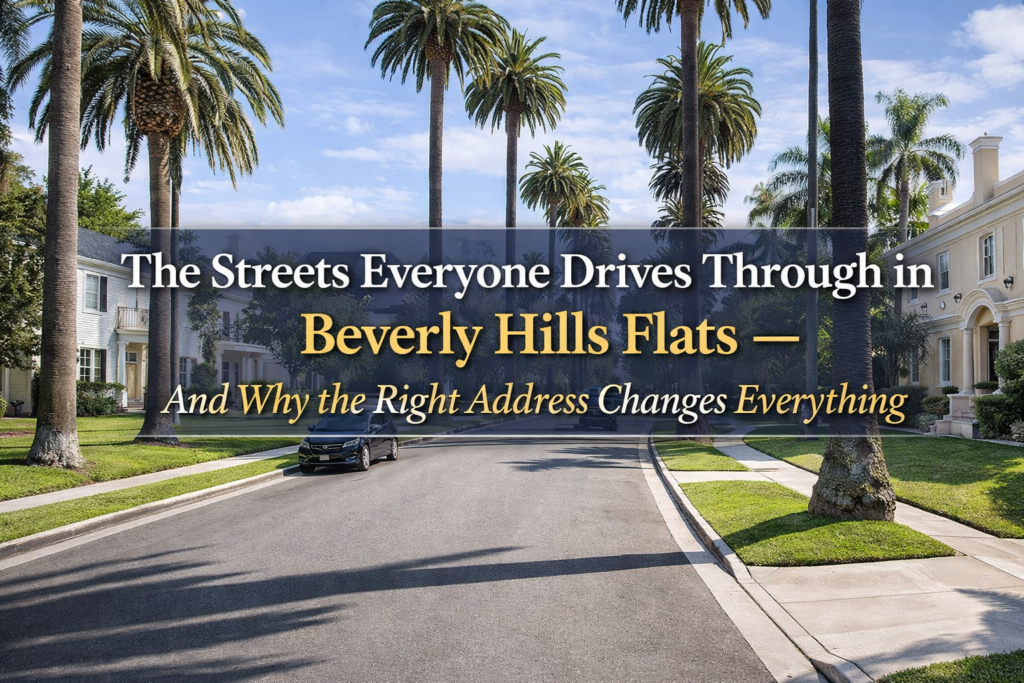
A buyer’s guide to cut-through traffic in the Beverly Hills Flats — which north-south streets carry daily Valley commuters, which quiet blocks like Sierra and Alta offer a better quality of life, and why street selection is one of the most important decisions you’ll make in this market.
By Jacob Lavian | Los Angeles Real Estate | jacoblavian.com
If you’re shopping for a home in the Beverly Hills Flats, you’ve probably noticed something that doesn’t show up on any listing sheet: some streets are quiet, private, and genuinely residential, while others carry a steady stream of cars throughout the day — cars that have nothing to do with your neighborhood at all.
This distinction is one of the most important and least-discussed factors in Beverly Hills Flats real estate. It affects your quality of life every single day. It affects your resale value. It affects how your kids play outside, how easily you pull out of your driveway, and whether you can have a conversation on your front porch without raising your voice.
If you’re working with a knowledgeable Los Angeles real estate advisor, they’ll walk you through exactly this before you ever make an offer. But if you’re still in the research phase, this guide will give you a clear picture of why street selection in the Flats is more nuanced than most buyers realize — and how to use that knowledge to your advantage.
Why the Beverly Hills Flats Has a Cut-Through Traffic Problem
To understand why certain streets in the Flats carry disproportionate traffic, you have to understand the geography of the entire region.
Beverly Hills sits between the Westside and the San Fernando Valley, and the main thoroughfare connecting them — the 405 freeway — is notoriously congested. Drivers heading from the Valley into West LA, Santa Monica, or Century City are constantly looking for alternatives to sitting in freeway gridlock. The canyon roads are an option, but they have their own delays and limitations.
So a significant portion of Valley commuters cut through the Beverly Hills Flats. They drop down from Mulholland or exit the freeway at various Westside on-ramps, then cut through the residential grid of the Flats to reach their destinations south or west. The north-south streets that align with traffic signals — particularly those with lights at Sunset Boulevard to the north and Santa Monica Boulevard to the south — become natural funnel points. They’re just efficient enough to save a few minutes, and that’s all it takes to turn a residential block into a de facto surface street.
The streets that bear the brunt of this are ones you’ll recognize immediately if you’ve spent any time in Beverly Hills: Hillcrest Road, Rexford Drive, Alpine Drive, Doheny Drive, North Beverly Glen Boulevard, North Canon Drive (which transitions into Beverly Glen north of Sunset), Whittier Drive, and North Beverly Drive. These streets don’t have bad addresses by any standard — Beverly Hills is Beverly Hills. But there’s a real and measurable difference between living on one of them and living on a street like Sierra Drive, Alta Drive, Carmelita Avenue, Lexington Road, or Elevado Avenue, which don’t align as cleanly with traffic signals and don’t serve as commuter shortcuts.
The Streets That See the Most Cut-Through Traffic
Let’s walk through the primary offenders one by one so you know exactly what you’re looking at when you’re evaluating properties.
Hillcrest Road
Hillcrest is a long, straight north-south run that carries commuters between Sunset and Santa Monica with minimal friction. It has signal access at both ends, which makes it appealing for drivers looking to bypass surface congestion. During peak hours — roughly 7:30 to 9:30 a.m. and 4:30 to 7 p.m. — traffic on Hillcrest is noticeably heavier than what you’d expect on a purely residential block. Homes on Hillcrest are attractive and often priced accordingly, but buyers need to visit during commute hours, not just on a Sunday morning open house, before making a decision.
Rexford Drive
Rexford is another north-south connector with strong signal alignment, making it a popular Valley cut-through. The street itself is lovely, lined with mature trees and well-kept properties. But its utility as a commuter route means you’ll notice consistent vehicle flow throughout the day. Morning rush hour especially — Rexford can feel more like a neighborhood arterial than a residential street during peak windows.
Alpine Drive
Alpine runs north-south through the heart of the Flats and is a well-known commuter route. It functions as a two-way street that connects easily with Sunset to the north and Santa Monica to the south. During the school year, you’ll also see school-related drop-off and pickup traffic layered on top of the commuter flow.
Doheny Drive
Doheny is one of the more pronounced examples on this list. It serves as a western boundary of the Beverly Hills Flats in this stretch, and it carries meaningful traffic from drivers coming down from the hills and the canyon. Doheny has the feel of a connector road in places — it transitions between neighborhoods in a way that keeps traffic moving through rather than within. Buyers considering Doheny-adjacent properties should account for noise and pedestrian comfort, particularly if they have young children or value outdoor privacy.
North Beverly Glen Boulevard and North Canon Drive
These two deserve to be mentioned together because they share an important characteristic: they continue north of Sunset and connect to the canyon road network. North Beverly Glen feeds into Beverly Glen Canyon, and North Canon Drive transitions into the canyon system above Sunset as well. This means they don’t just carry neighborhood traffic — they carry canyon commuters who are filtering down from the hills and the Valley into the Flats and the Westside beyond. The traffic volumes on these streets reflect their connectivity to a much larger network.
Whittier Drive
Whittier carries less traffic than some of the others on this list, but it still functions as a north-south cut-through with signal access. It tends to attract neighborhood traffic rather than heavy Valley commuters, but during peak hours you’ll still see a noticeable uptick in vehicles compared to the quieter streets one block over.
North Beverly Drive
North Beverly Drive is one of the primary north-south corridors in the Flats and arguably the most trafficked of the bunch. It’s a wide, well-signaled street with commercial activity at its southern end and transitions into a more residential character moving north — but it never quite sheds its arterial feel. Heavy through-traffic is a daily reality here, and buyers should weigh that carefully.
The Quiet Streets: What You Get When You Avoid the Commuter Grid
Here’s where the conversation gets interesting for serious buyers. The streets that don’t align as cleanly with commuter patterns — that don’t have signal setups inviting through-traffic, and that don’t connect logically to the canyon system or the Valley network — tend to be dramatically quieter.
Streets like Sierra Drive, Alta Drive, Carmelita Avenue, Lexington Road, Elevado Avenue, and Lomitas Avenue sit in the Flats but experience a fraction of the daily vehicle volume. Walk down Sierra Drive on a Tuesday afternoon and the difference is immediately apparent. These blocks feel genuinely residential in a way that the cut-through streets simply don’t.
The practical benefits compound over time.
Noise. Traffic noise is cumulative. You may not consciously register the hum of passing cars until you live somewhere without it. Buyers who move from a cut-through street to a quieter one consistently describe it as one of the best quality-of-life upgrades they’ve experienced — and they didn’t even know they were missing it.
Safety for children. Families with young kids place enormous value on being able to let children play in the front yard or walk to a friend’s house without constant vehicle monitoring. On the cut-through streets, that freedom is meaningfully reduced. On Sierra or Alta, it’s a genuine part of daily life.
Driveway access. Pulling in and out of a driveway on a high-traffic street is a low-grade stressor you deal with twice a day, every day. On a quiet block, it’s a non-issue.
Entertaining and outdoor living. A front patio, a low fence, a garden seating area — these features have real value on a quiet block. On a commuter corridor, the same features feel less appealing because of the proximity to moving traffic.
Resale. Sophisticated buyers know this distinction. When you go to sell, a home on a quiet interior street will attract buyers who specifically sought it out. A home on a cut-through street may require a pricing adjustment to compensate — particularly if comparable sales on quieter blocks have closed at stronger numbers.
How to Evaluate a Street Before You Buy
If you’re actively shopping in the Beverly Hills Flats, here’s a practical framework for assessing any street you’re considering.
Visit during rush hour. This is the most important thing you can do. An open house on a Sunday afternoon gives you almost no useful data about daily traffic conditions. Go back on a Tuesday or Wednesday morning between 8 and 9 a.m., and again in the evening between 5 and 6:30 p.m. Stand outside for ten minutes. Count cars. Notice the speed. That’s what life will actually look like from your living room or front yard.
Look at the signal patterns. Does the street have a traffic light at Santa Monica Boulevard? At Sunset? If yes, it’s on the commuter grid. That doesn’t automatically disqualify it — but it’s a real factor you need to price in and live with consciously.
Check the street’s northern terminus. Does the street continue north of Sunset and connect to a canyon or a through-route? If so, it will carry canyon traffic in addition to neighborhood traffic. The combination can be significant.
Talk to neighbors. Most homeowners on the cut-through streets have learned to live with the traffic — they’ve adapted. But ask them directly: “Does the traffic bother you? What’s it like during the week?” You’ll get honest answers, and you’ll appreciate them.
Look at the lot width and setback. On some of the higher-traffic streets, homes that sit on wider lots with deeper setbacks are more insulated from the road than their neighbors. A property set back forty feet from the curb is a different experience than one set back fifteen feet, even on the same block.
What This Means for Pricing in the Beverly Hills Flats
Here’s a reality that most buyers find counterintuitive: in the Beverly Hills Flats, the quietest streets don’t always carry the highest prices. Pricing in the Flats is driven by many factors — lot size, square footage, architectural quality, renovation level, and proximity to schools among them. A spectacular home on Hillcrest may very well close for more than a smaller home on Sierra, even if Sierra is quieter.
But when you’re comparing genuinely similar homes — similar size, similar quality, similar lot — the quiet-street premium is real. Buyers who’ve done their homework will pay more for a home on a residential block that doesn’t see commuter traffic. Sellers on those blocks have leverage that sellers on cut-through streets don’t.
For buyers, this creates an opportunity. If you’re working within a budget and you’re willing to accept a home on one of the higher-traffic streets, you may find properties that are priced more competitively relative to their square footage or lot size. The tradeoff is real, and only you can decide whether it’s worth it. But it should be a conscious decision, not one you back into accidentally.
This is exactly the kind of analysis that a Beverly Hills real estate specialist should be walking you through before you make an offer — not after.
The Valley Cut-Through Dynamic in Context
It’s worth stepping back and understanding the larger pattern at play here, because it helps explain why this issue is unlikely to improve materially over time.
The San Fernando Valley and the Westside are separated by the Santa Monica Mountains. The 405 freeway carries an enormous volume of daily commuters between them, and it is chronically congested during peak hours. There is no near-term infrastructure solution that changes this reality. Widening, high-occupancy lanes, and alternate routes are all stopgap measures against a population that continues to grow on both sides of the hills.
For drivers who live north of Sunset in Beverly Hills or in the canyons, the surface streets through the Flats are just convenient enough to use when the freeway backs up. For Valley commuters, the Flats serve as a transition zone between the canyon roads and their Westside destinations. Neither group is going away. This means the cut-through traffic on the streets we’ve discussed isn’t a temporary condition — it’s a structural feature of the neighborhood.
Buyers who understand this buy accordingly. They either decide that the traffic is an acceptable tradeoff for a particular property they love, or they prioritize a quieter block and understand they may pay a slight premium for that peace of mind.
Questions to Ask Your Agent About Street Selection in the Flats
If you’re working with a real estate agent on a Beverly Hills Flats purchase, here are the specific questions worth asking before you fall in love with any particular listing:
Is this street part of the commuter cut-through network between the Valley and the Westside?
Does this street have traffic signals at Sunset and Santa Monica that facilitate through-traffic?
Does this street connect north of Sunset to a canyon road system?
How does traffic on this block compare during weekday rush hours versus weekend mornings?
What have comparable homes on the quieter parallel streets closed for in the last twelve months?
Is there any pricing delta between this street and quieter alternatives, and what are we actually getting for that difference?
An agent who can answer these questions fluently — with specific data and firsthand knowledge — is an agent who’s actually going to protect your interests in this transaction. If you’re getting vague answers or being steered away from the questions, that’s useful information too.
Final Thoughts: The Address Inside the Address
Beverly Hills is a prestige market. The zip code, the school district, the cache of the address — these matter, and they should. But within Beverly Hills, and specifically within the Beverly Hills Flats, the address inside the address matters just as much.
The difference between a home on Hillcrest Road and a home on Sierra Drive isn’t just a matter of personal preference. It’s a measurable difference in daily quality of life, outdoor usability, noise level, safety for pedestrians and children, and long-term resale dynamics. In a market where you might be spending two, three, four million dollars or more, understanding that distinction isn’t a minor detail — it’s one of the most important things you can know.
The buyers who get the best outcomes in the Beverly Hills Flats are the ones who come in educated. They know which streets carry traffic, why, and what that means for price. They visit properties on Tuesday mornings, not just Sunday afternoons. They ask their agents hard questions and expect real answers. And they make their decisions with eyes open.
If you’re beginning to explore the Beverly Hills Flats — or if you’ve been looking for a while and want a clearer framework for evaluating your options — I’d welcome the conversation. You can reach me directly at jacoblavian.com or by calling (310) 346-4905. Understanding the nuances of this market is what I do, and helping buyers navigate exactly these kinds of decisions is a core part of the
representation I provideservices I offer. Whether you’re early in the process or close to making a move, I’m happy to walk you through what I know about these streets — and why it should matter to you.
Frequently Asked Questions About Beverly Hills Flats Streets and Cut-Through Traffic
1. Which streets in the Beverly Hills Flats have the most cut-through traffic?
The streets that consistently see the heaviest commuter cut-through traffic are North Beverly Drive, Hillcrest Road, Rexford Drive, Alpine Drive, Doheny Drive, North Canon Drive, North Beverly Glen Boulevard, and Whittier Drive. These streets all share a common trait — they align with traffic signals at Sunset and Santa Monica Boulevards, making them efficient shortcuts for Valley commuters trying to avoid the 405.
2. Why do Valley commuters cut through the Beverly Hills Flats specifically?
The Beverly Hills Flats sit in a geographic corridor between the San Fernando Valley and the Westside. When the 405 is backed up — which is most weekday mornings and evenings — drivers look for surface street alternatives. The north-south streets in the Flats that have signal access at major cross streets become natural funnels. They shave a few minutes off the commute, and that’s enough to make them part of thousands of drivers’ daily routines.
3. What are the quietest streets to buy on in the Beverly Hills Flats?
Streets like Sierra Drive, Alta Drive, Carmelita Avenue, Lexington Road, Elevado Avenue, and Lomitas Avenue tend to see significantly less through-traffic because they don’t align as directly with commuter signal patterns and don’t connect to canyon road systems north of Sunset. These blocks feel genuinely residential and are worth prioritizing if daily quiet and outdoor livability matter to you.
4. Does living on a high-traffic street in the Flats affect resale value?
It can, particularly when you’re competing against comparable homes on quieter blocks. Sophisticated buyers research this distinction, and some will specifically filter out high-traffic streets or expect a pricing concession to compensate. It doesn’t necessarily mean your home won’t sell well — but when two similar homes go head-to-head, the quieter street tends to have the edge.
5. Is the cut-through traffic problem in the Beverly Hills Flats likely to get better over time?
Realistically, no — not in any meaningful way. The structural issue is the geography: the Valley and the Westside are separated by the Santa Monica Mountains, the 405 is chronically over capacity, and the Flats sit right in the middle of the natural commuter path. Short of major behavioral shifts or infrastructure overhauls that aren’t on any near-term horizon, the commuter pattern is baked into these streets.
6. How can I tell if a street has cut-through traffic before I buy?
The most reliable method is visiting the property during weekday rush hours — specifically 7:30 to 9:30 a.m. and 4:30 to 6:30 p.m. Stand outside for ten minutes and observe the volume and speed of traffic. You can also check whether the street has signals at both Sunset and Santa Monica Boulevards, and whether it continues north of Sunset into the canyon network. Both are strong indicators of commuter utility.
7. Are homes on the quieter streets always more expensive than those on cut-through streets?
Not always — pricing in the Beverly Hills Flats is driven by many factors including lot size, square footage, condition, and architectural quality. A larger or more renovated home on a busier street may close for more than a smaller home on a quieter block. But when homes are genuinely comparable, the quiet-street premium is real and measurable. It’s one of the more nuanced pricing factors in this market.
8. Does cut-through traffic affect Beverly Hills Flats homes north of Sunset too?
The dynamics are different north of Sunset. The streets above Sunset in Beverly Hills — and into the hills more broadly — tend to be less grid-like and don’t serve as through-routes in the same way. Many are winding, narrow, or dead-end, which limits their appeal to commuters. The cut-through traffic problem is primarily a Flats issue, specifically the streets south of Sunset that align with the commuter grid.
9. What’s the best time to visit a property in the Beverly Hills Flats to get an accurate sense of the street?
Avoid open houses as your only data point — weekend mornings are the quietest time on most streets in the Flats and give you almost no useful information about daily conditions. Visit on a Tuesday or Wednesday morning during the school year if possible, and return in the early evening. The school year matters because it adds school-related traffic on top of the regular commuter flow on certain blocks.
10. Should cut-through traffic be a dealbreaker when buying in the Beverly Hills Flats?
Not necessarily — it depends entirely on your priorities. Some buyers are less sensitive to traffic noise and vehicle volume, particularly if they work from home less or spend most of their outdoor time in a backyard rather than a front yard. Others find it a genuine quality-of-life issue. What matters most is that you make the decision consciously, with full information, rather than discovering it after you’ve moved in. A good real estate advisor will make sure you understand exactly what you’re buying before you’re committed.
Jacob Lavian is a Los Angeles real estate advisor with over 12 years of experience representing buyers and sellers across Beverly Hills, the Westside, and Greater Los Angeles. CalDRE License #01956381.