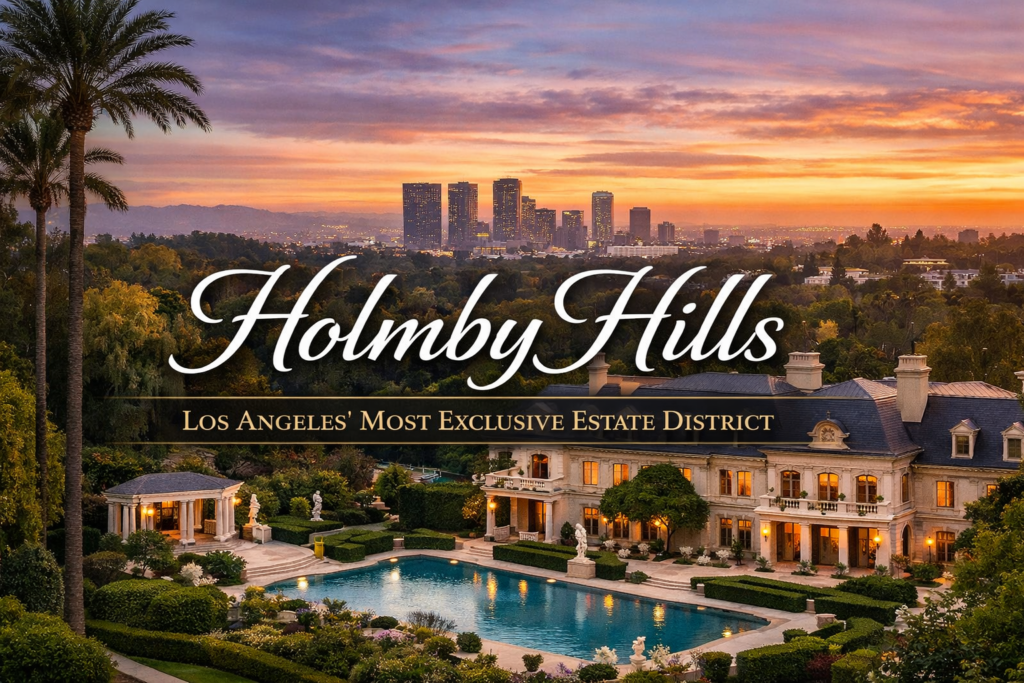
A street-level guide to Holmby Hills—the quiet, ultra-private neighborhood tucked between Beverly Hills and Bel Air that houses some of the largest private estates in Los Angeles and remains one of the least understood luxury addresses in the city.
By Jacob Lavian | Los Angeles Real Estate | jacoblavian.com
There is a triangle in Los Angeles that doesn’t appear on most tourist maps, doesn’t have a commercial corridor, and produces almost no noise. Bounded roughly by Sunset Boulevard to the south, Beverly Glen Boulevard to the west, and the edges of Beverly Hills to the east, Holmby Hills is one of the smallest, most private, and most expensive residential neighborhoods in the United States.
It is routinely grouped with its neighbors—Bel Air and Beverly Hills—as part of the “Golden Triangle” or “Platinum Triangle” of Los Angeles luxury real estate. But Holmby Hills is different from both. Beverly Hills is a city with a commercial heart, a downtown, a school district, and the visual trappings of wealth on display. Bel Air is an expansive hillside community with dramatic topography, canyon roads, and a wide range of price points from the accessible to the extraordinary. Holmby Hills is neither of these things.
Holmby Hills is, essentially, one large neighborhood of exceptionally private estates—sitting on flat to gently rolling land between Sunset and the hillside, with lot sizes that would be considered agricultural in most American cities and a residential character so consistent and so protected that it has changed remarkably little in the decades since the neighborhood was developed.
This guide takes you through Holmby Hills in the detail that matters if you’re considering a property here: the geography, the streets, the daily life reality, the relationship to its neighbors, and the real estate picture as it actually exists. If you’re exploring Holmby Hills real estate, Jacob Lavian works with buyers and sellers in this market at the level of access and discretion that significant estate transactions require.
Understanding Holmby Hills: Geography and Context
Holmby Hills is a neighborhood within the City of Los Angeles—not Beverly Hills, despite its proximity. This distinction matters more than it might seem: Holmby Hills properties are served by LAUSD, not Beverly Hills Unified School District, and their property taxes flow to LA County rather than the City of Beverly Hills. The neighborhood sits in the 90024 zip code, which it shares with Westwood.
The neighborhood boundaries are approximately: Sunset Boulevard to the south, Beverly Glen Boulevard to the west, Coldwater Canyon Avenue and the Beverly Hills city limit to the east, and Sunset’s curve northward as it approaches the Beverly Hills Hotel area. The actual developable residential area is compact—perhaps 600 to 700 acres in total—but within that compact footprint sit some of the most significant private estates in the country.
| Holmby Hills is not a neighborhood you pass through. There is no reason to drive its streets unless you live there or are visiting someone who does. That functional isolation is not incidental—it is the defining feature of what Holmby Hills offers. |
The terrain in Holmby Hills is notably different from the steep hillside topography of upper Bel Air or Benedict Canyon. The neighborhood sits on relatively flat to gently rolling land—a geological ledge between the flatter Beverly Hills basin to the east and the more dramatic Santa Monica Mountains terrain to the north and west. This flat topography is what allows the extraordinary lot sizes that define the neighborhood: you can build a 2-acre estate in Holmby Hills without engineering challenges that a comparably sized Bel Air hillside lot would demand.
The street grid is simple: Carolwood Drive, Club View Drive, Mapleton Drive, Charing Cross Road, St. Cloud Road—these are the primary residential streets of Holmby Hills, and understanding them is the beginning of understanding the neighborhood.
The Streets of Holmby Hills
Carolwood Drive
If there is a single most significant address in Holmby Hills, it may be Carolwood Drive. Walt Disney built his famous miniature railroad here. The Playboy Mansion—one of the most famous private residences in Los Angeles history—sits at 10236 Charing Cross Road, at the heart of Holmby Hills. Michael Jackson spent the final chapter of his life at 100 North Carolwood Drive. Aaron Spelling built what was for many years considered the largest single-family home in Los Angeles at 594 South Mapleton Drive.
Carolwood Drive runs north from Sunset, curving through the center of the neighborhood before connecting with the broader street pattern. Properties on Carolwood are among the most significant in Holmby Hills—large lots, mature landscaping, and the kind of visual privacy that comes from decades of established vegetation. Driveways on Carolwood are long. Gates are prominent. The homes themselves are largely invisible from the road.
Price points on and around Carolwood reflect the street’s status. Significant estates on Carolwood have traded at $30 million to $75 million and above for the most extraordinary properties—those with genuine acreage, significant square footage, and architectural distinction.
Mapleton Drive
Running roughly parallel to Carolwood, Mapleton Drive is another of Holmby Hills’ primary residential spines. The Aaron Spelling Estate—a 56,500-square-foot French Château-style compound on 4.7 acres at 594 South Mapleton—remains one of the defining properties in the neighborhood’s history. The property, known as The Manor, sold in 2011 for $85 million and again in subsequent years at prices that reflect the continuing demand for trophy estates in this neighborhood.
Mapleton Drive properties tend toward the formal and traditional in architectural character—French Normandy, English Tudor, and Spanish Colonial Revival estates built in the first half of the twentieth century alongside later construction that ranges from mid-century modern to contemporary. The common thread is scale: lots on Mapleton are measured in acres, not fractions of an acre.
Club View Drive and Charing Cross Road
The western edge of Holmby Hills, where Club View Drive runs along the Los Angeles Country Club golf course boundary, offers one of the most unusual residential amenities in the city: estates that back directly onto the private fairways of the Los Angeles Country Club—one of the most exclusive and most beautifully maintained private golf clubs in the country.
The Los Angeles Country Club occupies 325 acres at the heart of the Wilshire corridor—a vast green space that, combined with the Holmby Hills residential land adjacent to it, creates an extraordinary pocket of greenery and calm at the geographic center of one of the world’s most densely developed cities. Properties on Club View Drive and Charing Cross Road that look onto LACC fairways carry a premium that reflects the permanence of that green edge—these views will never be built out.
Charing Cross Road is also the location of the former Playboy Mansion—a 21,987-square-foot property on 5.3 acres that sold in 2016 for $100 million, setting a record price for a Los Angeles residential property at the time.
St. Cloud Road
St. Cloud Road extends from Sunset Boulevard northward into the upper reaches of the neighborhood, carrying properties with more pronounced hillside character than the flat-land estates of lower Holmby Hills. St. Cloud is perhaps the street in Holmby Hills that most resembles the adjacent upper Bel Air character—winding, steeply vegetated, with properties accessed via long driveways that climb from the road.
Price points on St. Cloud range from $8 million to $30 million+ for significant properties, with the most dramatic canyon-adjacent estates at the upper end of that range.
The Platinum Triangle: Holmby Hills, Bel Air, and Trousdale Estates
Holmby Hills is most often discussed as part of the “Platinum Triangle” of Los Angeles luxury real estate—a grouping that includes Holmby Hills, Bel Air, and occasionally Beverly Hills’ Trousdale Estates. Understanding how these three markets relate helps buyers calibrate where Holmby Hills fits in the overall luxury landscape.
Holmby Hills vs. Bel Air
Bel Air is dramatically larger than Holmby Hills and significantly more varied. The Bel Air experience ranges from relatively accessible hillside homes in the $2–3 million range to extraordinary estates on Stone Canyon Road, Stradella Road, and the upper reaches of the mountain at $20–75 million and above. Bel Air has topography, canyons, dramatic views, and the Bel Air Country Club at its heart.
Holmby Hills has none of Bel Air’s topographic drama—but it also has none of Bel Air’s accessibility. Holmby Hills is essentially a one-price-tier neighborhood: nearly everything here is significant, and the floor for a meaningful estate is considerably higher than in most of Bel Air. The flat land that limits Holmby Hills’ visual drama enables its extraordinary lot sizes—and those lot sizes are ultimately what make the neighborhood unique.
Holmby Hills vs. Trousdale Estates
Trousdale Estates is a mid-century planned community in Beverly Hills, developed from the 1950s onward on the hillside above the Beverly Hills flats. Its defining characteristics are flat-pad lots carved into the hillside (with panoramic views), the architectural language of California modernism, and a price tier that spans from the $5–8 million range for original-condition properties to $30–40 million and beyond for architecturally significant estates with extraordinary views.
Where Trousdale is about views and California modernism, Holmby Hills is about acreage, privacy, and the formal estate tradition. These are genuinely different buyers, and the two markets attract genuinely different architectural sensibilities.
The Los Angeles Country Club: The Green Heart of the Platinum Triangle
One feature that is unique to this part of the city—and that shapes all three of these markets—is the Los Angeles Country Club. The LACC’s 325 acres sit at the center of the Wilshire corridor, creating a permanent green void in the urban fabric that ensures the residential neighborhoods adjacent to it will never be overshadowed by high-density development.
For Holmby Hills specifically, LACC adjacency on the Club View Drive and Charing Cross Road edge of the neighborhood is one of the most valuable locational amenities available in Los Angeles real estate. The combination of the LACC’s green space, the privacy of the Holmby Hills street network, and the scale of the estates creates a residential experience that is genuinely without parallel in the city.
| The Los Angeles Country Club is one of the most exclusive private institutions in the United States—founded in 1897, consistently ranked among the best golf courses in the world, and operating a guest policy so restrictive that the club’s very existence is largely invisible to the general public. Its neighbors in Holmby Hills share something of that character. |
Real Estate in Holmby Hills: The Market Reality
Inventory and Transaction Volume
Holmby Hills has very few homes. The neighborhood’s compact geography and large lot sizes mean there are perhaps 200 to 250 residential parcels in the entire neighborhood—and in any given year, only a handful will trade. This extreme scarcity of supply is a fundamental characteristic of the Holmby Hills market: when a property comes available, it is a meaningful event, not a routine listing.
The off-market reality in Holmby Hills is more pronounced than in almost any other neighborhood in Los Angeles. Many of the most significant estate transactions in Holmby Hills history never appeared in the public MLS. They moved through agent relationships, quiet outreach to qualified buyers, and the kind of discreet process that sellers of $30–80 million estates require. Buyers serious about Holmby Hills need an agent with genuine relationships in the ultra-luxury market—not just MLS access.
Price Ranges
| Zone | Typical Range | Notes |
| Holmby Hills (City of LA) | $8M – $75M+ | Largest lots; most off-market |
| Adjacent Bel Air Crest | $6M – $30M+ | Gated community; 24/7 guard |
| Lower Bel Air / Stone Canyon | $4M – $20M+ | Canyon privacy; UCLA proximity |
| Trousdale Estates (BH) | $5M – $40M+ | Flat pads; panoramic views |
These ranges are necessarily broad given the extreme variance in lot size, condition, architectural quality, and view component that characterizes the Holmby Hills and adjacent luxury estate market. The most significant estates—those with multiple acres, substantial square footage, architectural distinction, and LACC or mountain view adjacency—trade at prices that cannot be bracketed by a simple range.
What Drives Holmby Hills Prices
- Lot size: In Holmby Hills, land is the primary asset. A 1-acre lot here is a floor—properties with 2, 3, 4, and 5+ acres command exponential premiums over smaller lots. Acreage in this location is permanently scarce.
- LACC adjacency: Properties that back onto or have views of the Los Angeles Country Club golf course command a measurable premium. The permanence of the green boundary—guaranteed by one of the most powerful private institutions in the city—is a real estate asset.
- Architectural significance: Historic estates with provenance—significant architects, notable former residents, architectural integrity—trade at premiums that reflect the story as much as the structure.
- Privacy infrastructure: Long driveways, established hedging and vegetation, motor courts, and the absence of through-traffic on the street itself all contribute to the privacy premium that Holmby Hills buyers are paying for.
- Flat pad vs. slope: The flat land of lower Holmby Hills generally commands a premium over the hillier St. Cloud Road properties—the flat pads allow larger livable footprints, more expansive landscaping, and easier guest house and pool configurations.
What Daily Life Actually Looks Like in Holmby Hills
The Drive
Holmby Hills is exceptionally well-located for Westside Los Angeles daily life. The neighborhood sits between Beverly Hills and Westwood, which means virtually all of the practical infrastructure of LA’s most desirable westside neighborhoods is accessible within a short drive.
Sunset Boulevard is the southern edge of the neighborhood and one of the primary east-west routes in Los Angeles. From Holmby Hills, Sunset takes you east to Beverly Hills and West Hollywood in 10–15 minutes, and west through Bel Air and Brentwood toward Pacific Palisades. Wilshire Boulevard—the other primary west-side artery—is five minutes south via Beverly Glen or Comstock Avenue.
The 405 Freeway is approximately 10 minutes west via Sunset or Wilshire—far enough to avoid freeway noise, close enough for airport access. LAX is 25–30 minutes south under non-peak conditions.
Grocery and Daily Errands
- Bristol Farms (Beverly Hills): The premium grocery standard for Holmby Hills residents—approximately 10 minutes east on Sunset.
- Whole Foods (Westwood): 5–7 minutes south, a standard for everyday grocery runs.
- Erewhon (multiple locations): The Melrose and Calabasas locations are both within 20 minutes; Erewhon’s product selection and prepared food section make it a regular destination for many Holmby Hills households.
- Beverly Drive corridor: 10 minutes east—dry cleaning, pharmacy, coffee, hardware, and the full daily-life infrastructure of Beverly Hills.
- Westwood Village: 5 minutes south—the UCLA-adjacent commercial district with restaurants, services, and a surprisingly functional everyday retail environment.
Dining
Holmby Hills residents have access to one of the most remarkable concentrations of dining in the country within 15 minutes. Beverly Hills’ Restaurant Row on La Cienega, the Sunset Strip’s chef-driven restaurants, the Brentwood and Santa Monica dining scenes, and the emerging West Hollywood culinary landscape are all within practical reach for weeknight dining.
The neighborhood itself has no restaurants—no commercial presence of any kind, in fact. This is not a criticism; it is a feature. Holmby Hills residents leave the neighborhood for dining, shopping, and entertainment, and they return to one of the quietest residential environments in the city.
Schools
As noted above, Holmby Hills is in LAUSD—not Beverly Hills Unified. Most families in Holmby Hills send their children to private schools, for which the Westside offers genuinely extraordinary options.
- Harvard-Westlake: The Westside campus in Studio City (and the middle school in Bel Air) is the default choice for many Holmby Hills families—one of the top college preparatory schools in the country.
- Brentwood School: 10 minutes west on Sunset—an exceptional K–12 independent school with strong athletics and a collaborative culture.
- Marlborough School: In Hancock Park, approximately 20 minutes east—the premier girls’ school in Los Angeles.
- Crossroads School: In Santa Monica, 20 minutes west—arts-integrated, progressive, and highly regarded.
- Loyola High School: Boys-only Jesuit college prep in Los Feliz—an option for families prioritizing a values-based environment.
Recreation and Outdoor Life
Holmby Hills Park—a quiet, beautifully maintained public park at the corner of Club View Drive and Comstock Avenue—is a neighborhood institution. The park has tennis courts, a rose garden, and the kind of maintained green space that feels anomalously serene for a neighborhood in the middle of a major city.
For more expansive outdoor recreation, Bel Air’s Stone Canyon Reservoir area, the Franklin Canyon Park system accessible via Benedict Canyon, and Griffith Park (30 minutes east) are all within reasonable reach. The Holmby Hills lifestyle is not a hiking-and-outdoor culture in the way that Benedict Canyon or Pacific Palisades can be—but access to genuine outdoor recreation is available to those who seek it.
Golf, of course, is a defining recreational feature of the neighborhood—or more precisely, the aspirational proximity to LACC. Membership at the Los Angeles Country Club is by invitation only, controlled by an indefinitely long waiting list, and essentially inaccessible to newcomers regardless of net worth. But the Hillcrest Country Club in Century City and the Bel-Air Country Club in Bel Air are both nearby alternatives with strong golf programs.
The History of Holmby Hills
Holmby Hills was developed beginning in the 1920s by Arthur Letts Jr., whose family had made its fortune through the Broadway department store empire. The Letts family owned the Wolfskill Ranch—a vast tract of citrus and farm land in what is now the heart of the Westside—and the development of Holmby Hills was part of the same planning vision that produced Westwood Village and the UCLA campus.
The neighborhood was conceived from the beginning as an estate district—large minimum lot sizes, deed restrictions that preserved the residential character, and covenants that controlled architectural standards. That original planning DNA is still visible in the neighborhood’s character today: Holmby Hills looks like a place that was designed to be what it is, rather than one that evolved organically.
Throughout the studio era, Holmby Hills became home to some of the most prominent figures in the entertainment industry. The Holmby Hills Rat Pack—the informal social circle of Humphrey Bogart, Frank Sinatra, Judy Garland, David Niven, and others who gathered at Bogart’s Mapleton Drive estate in the 1950s—took its name from the neighborhood. The social and cultural prestige of Holmby Hills was established in those years and has never fully dissipated.
Today the neighborhood’s residents are a mix of entertainment and media figures, technology and finance principals, international buyers who maintain Holmby Hills as a primary or secondary residence, and multigenerational families for whom the neighborhood has been home across generations. It is a neighborhood that takes its privacy seriously and wears its history quietly.
Holmby Hills vs. Other Ultra-Luxury LA Markets
Buyers approaching the ultra-luxury market in Los Angeles often compare Holmby Hills against a handful of competing neighborhoods. Here is how the comparison actually plays out:
- Holmby Hills vs. Beverly Park: Beverly Park is a gated hillside community above Beverly Hills with dramatic views and strong security infrastructure. It is newer, more visible in its luxury, and appeals to buyers who want the community-gated experience. Holmby Hills is older, quieter, more private in a different way—estate gating rather than community gating—and carries more historical depth.
- Holmby Hills vs. The Flats of Beverly Hills: The Beverly Hills flats—the grid of residential streets between Santa Monica Boulevard and Sunset—offers flat land, walkability to Beverly Hills’ commercial core, and Beverly Hills Unified School District access. Holmby Hills offers larger lots, more vegetation-based privacy, and a quieter street character. The Flats run $5–25 million; Holmby Hills runs $8–75 million and above.
- Holmby Hills vs. Malibu: Malibu and Holmby Hills are not direct competitors—they serve fundamentally different buyer priorities. Malibu buyers want ocean, lifestyle, and a degree of informality. Holmby Hills buyers want privacy, formality, centrality, and the estate tradition. Some buyers own in both; they are not substitutes.
- Holmby Hills vs. Bel Air (upper): Upper Bel Air offers more dramatic topography, more varied architecture, and—in the very best properties—canyon and city view combinations that Holmby Hills’ flat terrain cannot match. Holmby Hills offers larger flat lots, less road navigation, and a historically deeper sense of established estate character. Both are extraordinary; the choice depends on whether the buyer prioritizes acreage and flatness or topography and views.
Frequently Asked Questions: Holmby Hills Real Estate
Is Holmby Hills in Beverly Hills?
No—Holmby Hills is a neighborhood within the City of Los Angeles, not the City of Beverly Hills. It shares the 90024 zip code with Westwood and is served by LAUSD rather than Beverly Hills Unified School District. Despite its geographic proximity to Beverly Hills, it is a legally distinct municipality with different tax and school district implications.
What is the Platinum Triangle in Los Angeles real estate?
The Platinum Triangle refers to the cluster of ultra-luxury residential neighborhoods at the northwest corner of Los Angeles: Holmby Hills, Bel Air, and Beverly Hills (or sometimes Bel Air, Beverly Hills, and Trousdale Estates, depending on the source). The grouping reflects shared price tier and prestige rather than political boundaries—these neighborhoods collectively represent the highest concentration of ultra-luxury estate inventory in Los Angeles.
What are the most famous addresses in Holmby Hills?
Several properties have defined the neighborhood’s public identity over the decades: 594 South Mapleton Drive (the Aaron Spelling Estate / The Manor), 10236 Charing Cross Road (the former Playboy Mansion), 100 North Carolwood Drive (the former Michael Jackson estate), and the various Carolwood and Mapleton addresses associated with the Holmby Hills Rat Pack era. Most significant current properties are deliberately not identified publicly.
How is Holmby Hills different from Bel Air?
Bel Air is a much larger community with significant topographic variation, a wide range of price points, and a more varied architectural landscape. Holmby Hills is smaller, flatter, and more uniformly estate-tier in its pricing. Bel Air has hillside properties, canyon roads, and dramatic views; Holmby Hills has flat to gently rolling land, larger flat-pad estates, and LACC golf course adjacency. Bel Air is more varied; Holmby Hills is more consistently ultra-luxury.
What is the price range for homes in Holmby Hills?
The Holmby Hills market is essentially all estate-tier. Entry-level properties—smaller lots, original condition, less architectural distinction—begin around $8–10 million. Mid-range significant estates on 1–2 acres trade in the $15–35 million range. The most extraordinary properties—those with multiple acres, significant square footage, architectural distinction, or LACC adjacency—have traded at $75 million to $100 million at the apex of the market.
Are there off-market properties in Holmby Hills?
Yes—and the off-market proportion is higher in Holmby Hills than in virtually any other Los Angeles neighborhood. Many of the most significant transactions in Holmby Hills history have occurred entirely off-market, moving through agent relationships and quiet buyer outreach rather than public MLS listings. Buyers serious about Holmby Hills must work with an agent who has genuine relationships at this level of the market—MLS access alone is not sufficient.
Can Jacob Lavian help me buy or sell a property in Holmby Hills?
Yes. Jacob Lavian works with buyers seeking estate properties in Holmby Hills and the adjacent Platinum Triangle markets, and with sellers looking to position significant assets for the most qualified buyers—both on-market and off. Given the discretion required and the off-market nature of significant transactions in this area, relationship-based representation is essential.