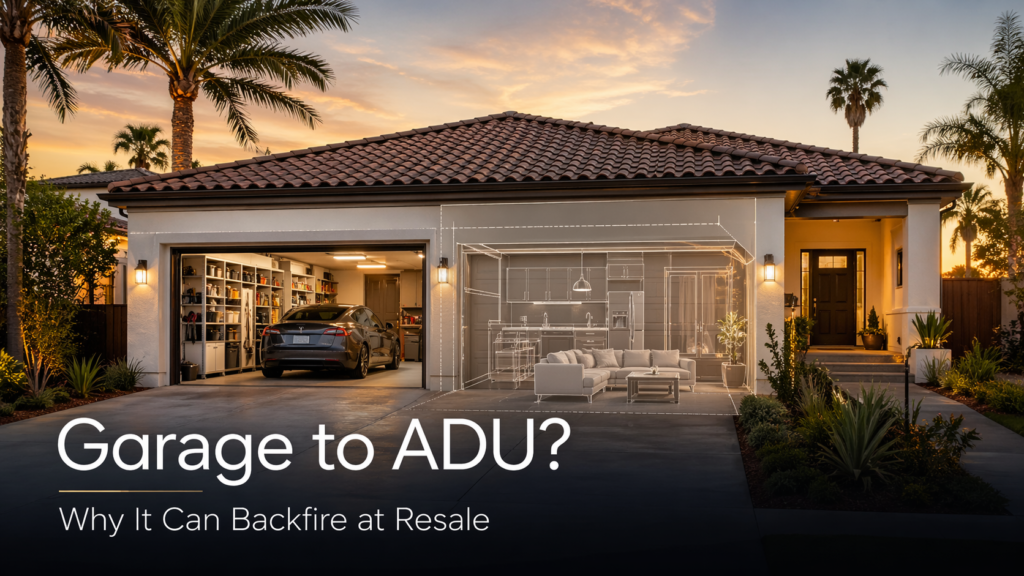
Garage conversions have become one of the hottest ideas in residential real estate. On paper, the pitch sounds easy: take a space that is already built, turn it into a livable unit, and add more usable square footage to the property. A lot of owners immediately jump to the same conclusion: if homes in the neighborhood are selling for $700 per square foot, then converting the garage into an ADU should create the same kind of value.
That is where many homeowners get themselves into trouble.
Real estate value is not just about math. It is about what the market actually wants. A garage converted into an ADU may look like an easy way to “increase value,” but buyers do not all see that added space the same way. Some may love it. Some may view it as neutral. Some may see it as a negative. And some may discount the property because the home no longer functions the way a true single-family home is expected to function.
That is especially important in Los Angeles, where buyers often pay a premium for flexibility. A real garage is not just a place to put a car. It can be covered parking, secure storage, a workspace, inventory space for a business owner, a buffer for seasonal items, a place for tools, a home gym, or simply an amenity that makes day-to-day life easier. Once that garage is gone, it is gone. And the market does not always reward the owner for removing it.
If you are considering converting your garage, or if you already did, the smarter question is not “How many square feet am I adding?” The smarter question is: What kind of buyer am I attracting, and what kind of buyer am I pushing away?
For sellers thinking strategically about value, functionality, and buyer demand, this is exactly the kind of issue that should be evaluated before making a major change. If you are looking for Los Angeles real estate guidance with a more practical lens on what buyers actually respond to, this is where the conversation needs to start.
The Mistake: Assuming All Square Footage Is Equal
One of the biggest misconceptions homeowners have is believing that all square footage carries the same value. It does not.
A primary house, a beautifully integrated addition, a detached guest house, a bonus room, a converted garage, and a legal ADU may all add “space,” but the market may value each one very differently. Buyers do not analyze property the same way a spreadsheet does. They look at layout, utility, privacy, convenience, parking, storage, and the overall feeling of how the property lives.
This is where garage conversions can backfire. An owner may think, “I added 400 square feet, so I added 400 square feet of value.” But buyers may think, “This used to be a garage, and now I have nowhere to park, nowhere to store anything, and the extra unit does not really help me.”
That disconnect matters.
In some cases, an ADU may absolutely enhance value. But in other cases, the conversion creates a tradeoff that the seller is underestimating. It is not just about what was added. It is about what was lost.
Why Some Buyers Still Pay Top Dollar for a Single-Family Home With a Real Garage
There is still a strong segment of the market that wants a traditional single-family home with a usable garage, and they are often willing to pay for it.
Why? Because convenience matters. Privacy matters. Protection matters. Daily lifestyle matters.
A garage offers a level of functionality that many buyers do not fully appreciate until it is missing. Covered parking protects vehicles from sun, heat, dust, debris, tree sap, and weather exposure. It provides security. It makes unloading groceries easier. It helps parents with children. It matters to people with nicer cars, leased cars, collector vehicles, motorcycles, or simply people who do not want to deal with street parking or an exposed driveway setup.
In many neighborhoods, parking is not a minor detail. It is part of how a property competes. A home with a true garage may appeal more strongly to buyers who value order, storage, and a cleaner overall living experience. A buyer who has spent years parking outside may see a real garage as a lifestyle upgrade. A buyer who works long hours may want the ease of pulling into covered parking at the end of the day. A buyer with children may care about direct access into the house. A buyer with tools, equipment, outdoor gear, or inventory may see the garage as a necessity, not a bonus.
This is where broad assumptions about “added living space” can miss the point. For a lot of buyers, the garage was already valuable before the conversion ever happened.
Covered Parking Is More Important Than People Think
One of the strangest things about garage conversion conversations is how casually people dismiss parking. They act like the loss of a garage is no big deal because “you can just park outside.” That may sound fine in theory, but it often ignores how buyers actually live.
Parking outside is not the same as parking inside a covered, enclosed, protected space. Not even close.
For many buyers, parking in a garage is tied to peace of mind. It protects their vehicle. It keeps the car cooler. It reduces wear from constant exposure. It offers a sense of security. It can also reduce the daily hassle of finding the “best” parking spot, dealing with tight driveway arrangements, or worrying about what is left visible in the car.
There is also an emotional layer to this. Buyers do not just buy square footage. They buy comfort, ease, routine, and the feeling that a home makes life work better. A garage helps create that feeling. When it is gone, the loss is often bigger than homeowners expect.
In some price ranges, that loss may be tolerated. In others, it can absolutely affect desirability. Buyers spending serious money on a single-family home often expect certain features to still exist. A missing garage can make the property feel compromised, even if the conversion itself is attractive.
Garages Are Not Just for Cars
This is another major blind spot.
People talk about garages as if their only purpose is vehicle parking. In reality, garages are one of the most flexible parts of a property. They often function as a storage hub, business workspace, inventory room, hobby area, or overflow utility zone.
That matters even more today because many buyers are not living one-dimensional lives. Some run small businesses from home. Some sell products online. Some need room for staging inventory, shipping supplies, tools, samples, materials, or equipment. Some want space for bikes, holiday items, luggage, emergency supplies, workout equipment, or home improvement gear. Others simply do not want those things cluttering the interior of the house.
Take away the garage, and where does all of that go?
The answer is often: nowhere good.
It ends up in closets, spare bedrooms, hallways, sheds, side yards, or stacked awkwardly inside the house. That may not sound like a pricing issue, but it absolutely can become one because buyers do not only evaluate square footage. They evaluate how easy the property will be to live in after they move in.
A house with a garage can feel more functional than a house with slightly more interior square footage but no place to store anything.
The ADU Trend Has Created a Very Simplistic Value Narrative
Right now, there is a common trend in the market where owners hear about ADUs and immediately think: “This is free value.” They see headlines, social media clips, and general conversations about accessory dwelling units and start assuming that any extra living area automatically increases resale value on a dollar-for-dollar basis.
That is an oversimplified way to look at real estate.
Yes, there are situations where an ADU adds meaningful value. Yes, there are buyers who want multigenerational living, guest space, rental income potential, or a separate office/studio setup. But that does not mean every garage conversion will be valued at the same price per square foot as the main house.
That assumption is where many owners get burned.
If the market price of nearby homes is around $700 per square foot, that does not automatically mean a converted garage is worth $700 per square foot. In many cases, it may not be worth anywhere near that. It may be viewed as a secondary improvement with limited usefulness to the next buyer. It may be helpful only to a narrower buyer pool. It may come with parking tradeoffs that reduce the property’s appeal. And if the design, privacy, access, or finish quality is weak, the market may barely reward it at all.
Real estate is full of examples where owners spent money based on personal logic, only to find out buyers did not share that logic.
The Buyer Does Not Have to Value Your ADU the Way You Do
This is one of the hardest truths for sellers to accept.
Just because you spent a lot of money creating an ADU does not mean the next buyer will value it the same way. Buyers are not reimbursing owners for effort. They are paying based on what the property is worth to them.
If the next buyer has no interest in renting out the space, does not need a guest suite, does not want an office in the backyard, and would strongly prefer a real garage, then your expensive conversion may not create the premium you expected. In fact, that buyer may mentally subtract value because they are already thinking about the cost and hassle of turning it back.
That is the danger with trend-driven improvements. Owners often build for an imagined market instead of the actual market.
The question is not whether an ADU has some theoretical benefit. The question is whether the most likely buyers for your location, price point, and home style will see it as an upgrade or a compromise.
Functionality Still Sells
In real estate, flashy upgrades get attention, but functionality often wins.
A beautifully staged home can attract clicks. A stylish kitchen can generate excitement. But the homes that hold value best over time usually solve practical lifestyle problems. Parking is practical. Storage is practical. Covered access is practical. Flexible utility space is practical.
That is why some buyers will pay top dollar for a true single-family setup that still includes a garage. It preserves optionality. They can park in it, store in it, work in it, or leave it empty until they decide. The point is that the option still exists.
Once the garage is converted, that optionality narrows. The seller has made the decision for the next buyer. And the more specific the improvement, the greater the risk that the next buyer does not want it.
That is a major reason sellers should think carefully before removing one of the most flexible amenities on the property.
When a Garage Conversion Makes More Sense
To be clear, this is not an argument that garage conversions are always bad. They are not.
There are situations where converting a garage can make a lot of sense. For example, if the property already has abundant parking, if the buyer profile in that area strongly favors income-producing setups, if the ADU is done legally and well, if the layout is excellent, and if the property’s highest and best use leans more toward flexibility or rental income than traditional single-family utility, then the conversion may be beneficial.
But that is a much more specific analysis than simply saying, “I added square footage, so I added equal value.”
That is why sellers should evaluate the likely buyer profile first. Is the future buyer more likely to want a tenant, or a garage? More likely to care about side income, or secure parking? More likely to want detached living space, or a cleaner single-family layout? Those questions matter more than generalized ADU hype.
This Is Especially Important for Sellers Who Care About Resale
Homeowners who plan to stay forever may look at this differently. They may prioritize personal use, family needs, or a very specific lifestyle benefit. That is their call.
But if resale matters, then marketability matters.
And if marketability matters, then owner decisions should not be made in a vacuum. Before converting a garage, the smarter move is to think several steps ahead. What buyer are you designing for? Are you improving the property, or are you making it more niche? Are you broadening the appeal, or shrinking the pool? Are you creating value, or just creating cost?
Those are the types of questions sellers should ask before spending serious money on a project that may not translate cleanly into resale dollars.
If you want to understand how a property improvement might affect your positioning in the market, working with someone who understands both buyer psychology and property strategy matters. You can learn more about Jacob Lavian and the more strategic approach behind how properties are evaluated and marketed.
Think Like the Next Buyer, Not the Current Trend
Trends can be helpful, but they can also be dangerous when owners follow them blindly.
Right now, garage-to-ADU conversions are often treated like an automatic value add. But real estate is not that simple. The market does not reward every improvement equally, and it definitely does not guarantee that secondary living space will be valued the same as primary living space.
Some buyers will love the ADU. Some will not care. Some will wish the garage had never been touched.
That is why homeowners should slow down before assuming the conversion will pay off. In many cases, a true single-family home with a garage still offers stronger all-around appeal because it provides parking, storage, flexibility, security, and daily ease. Those things may not sound glamorous, but they are exactly the kinds of features that keep properties broadly desirable.
And broad desirability is often where strong resale value lives.
If you are weighing whether to convert, sell, reposition, or market a property more strategically, take the time to look at the decision through the eyes of the next buyer. That is often where the real answer shows up.
For owners who want a more thoughtful plan before making a move, explore real estate services in Los Angeles, review recent real estate results, or contact Jacob Lavian to discuss your property and your goals.
Frequently Asked Questions
Does converting a garage into an ADU always increase home value?
No. It can increase value in some cases, but it does not automatically increase value on a dollar-for-dollar basis. A lot depends on the neighborhood, parking situation, buyer profile, legality of the conversion, layout, and whether buyers see the ADU as useful or as a tradeoff.
Will buyers pay the same price per square foot for a garage ADU as they would for the main house?
Not necessarily. Many homeowners assume the ADU will be valued at the same price per square foot as the main residence, but that is often too simplistic. Secondary space may be valued differently depending on function, privacy, quality, and what the buyer actually wants.
Why do some buyers still prefer a home with a garage instead of an ADU?
Because a garage provides practical value. Buyers may want covered parking, secure storage, room for tools or equipment, space for inventory if they run a business, or simply a more traditional single-family layout. For many buyers, losing the garage feels like losing flexibility.
Is covered parking really that important to buyers?
For many buyers, yes. Covered parking can protect vehicles, improve convenience, create a sense of security, and make the property feel more functional on a daily basis. In some neighborhoods and price points, that can matter a lot.
Can a garage be more valuable as storage than as living space?
Absolutely. A garage can be highly valuable for storage, business inventory, tools, seasonal items, workout equipment, bikes, and general household overflow. Some buyers would rather keep that flexible utility space than gain a small secondary unit.
When does converting a garage into an ADU make more sense?
It may make more sense when the property has strong alternative parking, the area has clear demand for separate living quarters or rental income, the conversion is done legally and well, and the likely buyer is expected to value the added unit more than the lost garage.
Should I convert my garage before selling my home?
That depends on your property, neighborhood, price point, and buyer pool. Before making that decision, it is smart to evaluate whether the conversion will truly expand appeal or whether it could make the property more niche. A market-specific strategy matters.
Who should I talk to before deciding whether a garage conversion will help or hurt resale?
You should talk to a real estate professional who understands buyer behavior, property positioning, and how specific improvements affect marketability in your area. The right advice is rarely just about cost per square foot.