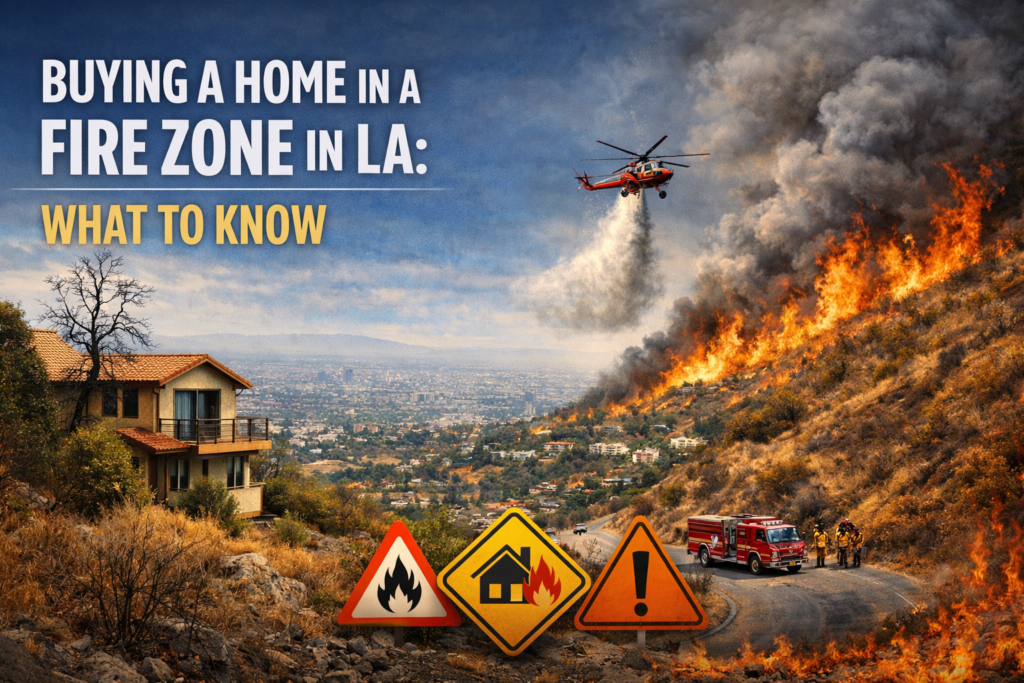
Fire risk has permanently changed the calculus of buying a home in hillside, canyon, and foothill areas of Los Angeles. Here is everything buyers need to know before making an offer on a property in or near a fire hazard zone.
By Jacob Lavian | Los Angeles Real Estate | jacoblavian.com
The hills and canyons of Los Angeles are some of the most beautiful and most sought-after places to live in the world. The views, the privacy, the connection to nature, the architectural heritage — all of it makes hillside living in LA genuinely extraordinary. And for decades, the fire risk that comes with that geography was something most buyers acknowledged in the abstract without fully understanding in practice.
That has changed. The fires that have devastated communities across LA — Palisades, Altadena, Malibu, Sylmar, and others — have fundamentally shifted how buyers, lenders, and insurers think about hillside and canyon properties. Fire risk is no longer a disclosure footnote — it is a central underwriting variable that affects insurability, financing, property value, and the practical reality of living in affected zones.
This guide is written for buyers seriously considering a home in or near a fire hazard zone in Los Angeles. It covers what the fire hazard zone designations mean, what the insurance crisis actually looks like for buyers today, how to evaluate a specific property’s fire risk, what fire hardening means and whether it matters, and how to make a fully informed decision before you commit. If you’re evaluating hillside or canyon properties in LA, Jacob Lavian can help you understand the fire risk profile of any specific property and what it means for your financing, insurance, and long-term ownership.
Understanding Fire Hazard Severity Zones in California
California classifies land into fire hazard severity zones based on fuel load, slope, fire weather, and ember production potential. These designations — maintained by CAL FIRE and local jurisdictions — determine building code requirements, disclosure obligations, and broadly inform insurance underwriting decisions.
The Three Zone Designations
- Moderate Fire Hazard Severity Zone: The lowest of the three CAL FIRE designations. Properties in moderate zones have some fire risk but are not subject to the most stringent fire hardening requirements. Insurance is generally available, though premiums are elevated relative to non-zone properties.
- High Fire Hazard Severity Zone: Properties with meaningful fuel loads, topographic factors, and fire weather exposure. Specific building standards apply to new construction and major renovations. Insurance is available but increasingly expensive and subject to underwriting scrutiny.
- Very High Fire Hazard Severity Zone (VHFHSZ): The designation that carries the most significant implications for buyers. Properties in VHFHSZs are subject to the most stringent building and vegetation management requirements, face the most challenging insurance environment, and are the properties most directly affected by California’s insurance market crisis. A large proportion of the hillside and canyon properties in the Santa Monica Mountains, Verdugo Hills, Malibu, and foothill communities carry this designation.
How to Check a Property’s Fire Hazard Zone Designation
CAL FIRE maintains a publicly accessible map of fire hazard severity zones at osfm.fire.ca.gov. You can search any California address and see its current designation. The Natural Hazard Disclosure (NHD) report — provided by the seller as part of every California real estate transaction — also identifies whether a property is in a designated fire hazard zone.
Do not rely solely on the NHD report. Check the CAL FIRE map directly, verify the zone with your insurance broker before removing contingencies, and understand that zone boundaries can be updated — a property that was outside the VHFHSZ a year ago may now be inside it following a CAL FIRE reassessment.
Critical: The fire hazard zone designation tells you about general risk category — it does not tell you about a specific property’s individual risk based on vegetation management, home construction, access roads, or proximity to fuel sources. Two homes in the same VHFHSZ can have dramatically different actual risk profiles based on how they’ve been maintained and hardened.
The Insurance Crisis: What Buyers Are Actually Facing in 2026
The most immediate and practical challenge facing buyers of fire zone properties in Los Angeles is not the fire risk itself — it’s the collapse of the standard homeowners insurance market in high-risk areas. This is not hyperbole. Major insurers including State Farm, Allstate, Farmers, and others have dramatically reduced or eliminated new policy writing in California’s high-risk fire zones, leaving buyers with a market that is both more expensive and less comprehensive than it was just a few years ago.
What the Insurance Landscape Looks Like for Fire Zone Buyers
- Standard market insurers: Many are no longer writing new policies in VHFHSZs in Southern California. If you find a property currently insured by a standard carrier, that policy may not be transferable to you as a new buyer — verify before you close
- Surplus lines insurers (E&S market): Non-admitted insurers who can write policies that standard carriers won’t. Coverage is available but premiums are dramatically higher — often $10,000–$30,000+ per year for hillside properties that previously cost $3,000–$5,000 to insure. Coverage terms are also often more restrictive
- California FAIR Plan: The state’s insurer of last resort — available to any California property owner but providing only basic fire coverage without the liability, theft, and additional living expense coverage of a standard homeowners policy. FAIR Plan policies typically need to be supplemented with a “Difference in Conditions” (DIC) policy to approximate standard homeowners coverage. Combined cost can still be $15,000–$40,000+ per year
- Coverage gaps: Even when insurance is available, coverage limits, replacement cost calculations, and exclusions in surplus lines and FAIR Plan policies may leave homeowners significantly underinsured relative to actual rebuild costs in LA’s expensive construction market
Why This Matters for Financing
Lenders require homeowners insurance as a condition of funding any mortgage. If you cannot obtain adequate insurance at a reasonable cost, your lender will not fund your loan. This is not a theoretical risk — buyers have lost deals in escrow when insurance quotes came back at levels that made the monthly payment untenable or when insurance simply wasn’t available at any price for the specific property.
Before you remove your inspection contingency or any other contingency on a fire zone property, get an insurance quote from at least two brokers who specialize in high-risk California properties. Do this early in escrow — not the week before closing. An uninsurable property is an unbuyable property.
The Right Insurance Brokers for Fire Zone Properties
Standard insurance agents often cannot help with fire zone properties — they work with admitted carriers who aren’t writing in these areas. You need a surplus lines broker or an independent agent with California high-risk fire zone expertise. Ask your agent for referrals, or search the California Department of Insurance’s licensed surplus lines broker database. Getting quotes from multiple brokers is essential — the E&S market has significant premium variation.
How to Evaluate a Specific Property’s Fire Risk
The fire hazard zone designation is a starting point — not a complete picture. Two properties in the same VHFHSZ can have dramatically different actual risk profiles based on factors specific to the property and its immediate surroundings. Here’s how to evaluate a property’s actual fire risk beyond the zone designation:
Defensible Space Assessment
California law requires that properties in fire hazard zones maintain defensible space — vegetation-cleared zones around the structure that reduce fire spread risk:
- Zone 1 (0–30 feet): Immediate zone around the structure — vegetation should be sparse, well-separated, and non-combustible. No dead vegetation, wood piles against the structure, or continuous fuel paths to the building
- Zone 2 (30–100 feet): Extended zone where vegetation is reduced and managed to reduce fire intensity and rate of spread. Trees should be well-spaced with cleared understory
Evaluate the property’s current defensible space compliance during your inspection. A property with overgrown vegetation against the house, dead brush on steep slopes above the structure, or wood fences connecting to combustible landscaping has measurable, documented higher fire risk that may affect insurance availability and premium
Home Hardening Features
How a home is built and maintained significantly affects its fire survivability. Key features to evaluate:
- Roof material: Class A fire-rated roofing (composition shingles, metal, tile, concrete) provides the best protection. Wood shake roofs — still found in older hillside homes — are among the highest fire risks
- Vents and openings: Ember intrusion through attic vents, eave vents, and other openings is a primary mechanism of home ignition. Ember-resistant vents with fine mesh screening significantly reduce this risk
- Exterior cladding: Non-combustible or fire-resistant exterior materials (stucco, concrete, fiber cement) perform dramatically better than wood siding or wood decking in fire conditions
- Deck and patio construction: Combustible wood decks adjacent to the structure create a direct fuel path. Composite decking or concrete substantially reduces ignition risk
- Windows: Single-pane windows can fail in radiant heat. Dual-pane or tempered glass provides meaningfully better fire resistance
- Gutters: Metal gutters with ember guards prevent accumulation of combustible leaf debris
Access and Evacuation Routes
One of the most overlooked fire risk factors in hillside properties is access and evacuation. Properties at the end of a single-access road — particularly narrow, winding canyon roads — face evacuation challenges that properties with multiple exit routes do not. Ask:
- How many road access points does the neighborhood have?
- Is the road wide enough for two vehicles to pass, including emergency apparatus?
- Has the road flooded, washed out, or been blocked in past fire or weather events?
- How long does evacuation realistically take during peak traffic or emergency conditions?
The Palisades and Altadena fires demonstrated with devastating clarity how single-access road limitations can trap residents during evacuations. Access and egress is a life-safety issue, not just a convenience consideration.
Proximity to Fuel Sources
Beyond the property itself, evaluate the surrounding landscape. A well-hardened home on a well-managed property is still at elevated risk if it sits directly below a steep, chaparral-covered canyon wall or adjacent to decades of accumulated brush in a neighboring property. The ember cast zone — how far burning embers can travel from an active fire front — extends well beyond the immediate property boundary. Evaluate what’s burning around the property, not just what’s on it.
Disclosures: What Sellers Are Required to Tell You
California sellers of property in fire hazard zones have specific disclosure obligations beyond standard real estate disclosures:
- Natural Hazard Disclosure (NHD): Identifies whether the property is in a state or locally designated fire hazard zone
- Defensible space compliance: Sellers must disclose whether the property currently meets defensible space requirements
- Fire hardening: AB 38 (effective 2020) requires sellers of properties in high fire risk areas to provide documentation of fire hardening compliance or disclose that the property has not been inspected
- Prior loss history: Sellers must disclose any prior fire damage to the property, prior insurance claims related to fire, and any notices from local fire agencies regarding code compliance
- Known material defects: Any known condition that affects fire safety — a failed roof, non-compliant vents, unmaintained defensible space — should be disclosed on the Transfer Disclosure Statement
Review all fire-related disclosures carefully and do not assume that “no known issues” means the property is adequately hardened or properly maintained. Use the disclosures as a baseline and conduct your own independent assessment through the inspection process.
The Financial Reality: Running the True Numbers
When evaluating a fire zone property in Los Angeles, the purchase price is only the beginning of the financial picture. Run the true all-in cost of ownership before you commit:
Insurance Premium Impact
Get your insurance quote before you make an offer if possible — or at minimum before you remove contingencies. At $20,000–$40,000 per year in insurance premiums on a hillside property, the annual cost of fire insurance can exceed your property tax bill. Factor this into your monthly housing cost calculation, not as a footnote but as a primary budget line item.
Fire Hardening and Defensible Space Costs
If the property needs fire hardening improvements — roof replacement, vent upgrades, deck replacement, landscaping — get contractor estimates as part of your due diligence. A complete fire hardening package on an older hillside home can cost $50,000–$150,000. This is a real cost that affects your all-in acquisition price and may qualify for negotiation with the seller.
Ongoing Defensible Space Maintenance
Maintaining legally required defensible space requires ongoing vegetation management — typically $2,000–$6,000 per year depending on lot size, vegetation density, and access. This is not optional — CAL FIRE and local fire agencies conduct defensible space inspections and can issue compliance orders with real consequences for non-compliant properties.
Long-Term Value Considerations
Fire zone designation affects resale — the pool of buyers for a VHFHSZ property is meaningfully smaller than the pool for a comparable property outside fire zones, because many buyers are unwilling to navigate the insurance and risk considerations. Pricing a fire zone property correctly at purchase protects your ability to sell at a fair price in the future.
The Case for Still Buying in Fire Zones
Everything above might make fire zone buying sound categorically inadvisable. That’s not the conclusion. Many of the most beautiful, most private, and most appreciated properties in Los Angeles are in or near fire zones — and buyers who approach them with clear eyes, thorough due diligence, and realistic expectations make excellent long-term real estate decisions.
The buyers who do best with fire zone properties are those who:
- Understand the insurance landscape before they offer and have verified insurability at acceptable cost
- Budget honestly for fire hardening, defensible space maintenance, and premium insurance as part of their total ownership cost
- Choose properties that are well-hardened, well-maintained, and in neighborhoods with good access and egress
- Have a long-term ownership horizon — fire zone properties trade at a discount relative to comparable non-fire-zone properties, which means buyers who hold through market cycles often benefit from the price entry point
- Are emotionally and financially prepared for the possibility of evacuation and the risks that come with canyon and hillside living
The goal is not to avoid fire zone properties categorically — it is to buy them with complete information and realistic expectations. That’s what this guide is for.
Frequently Asked Questions: Buying in a Fire Zone in Los Angeles
How do I know if a home is in a fire hazard zone in California?
Check the CAL FIRE Fire Hazard Severity Zone map at osfm.fire.ca.gov and search the property address. The seller’s Natural Hazard Disclosure report will also identify fire zone status. Your insurance broker can confirm the designation and its insurance implications before you commit to a property.
Can I get homeowners insurance for a home in a fire zone in LA?
Insurance is available — but the landscape has changed dramatically. Standard admitted carriers have largely stopped writing new policies in VHFHSZs in Southern California. Surplus lines insurers and the California FAIR Plan are the primary options, both at significantly higher cost than pre-crisis standard market policies. Get quotes early in your due diligence process — before removing contingencies.
What is the California FAIR Plan?
The California FAIR Plan is the state’s insurer of last resort — available to any California homeowner who cannot obtain standard market coverage. It provides basic fire coverage but does not include the liability, theft, and additional living expense coverage of a standard homeowners policy. Most FAIR Plan policyholders supplement it with a Difference in Conditions (DIC) policy to approximate full homeowners coverage. The combined cost can still be $15,000–$40,000+ per year for high-risk properties.
What is defensible space and am I required to maintain it?
Defensible space is the vegetation-cleared buffer zone around your home required by California law for properties in fire hazard zones — 30 feet of sparse, managed vegetation immediately around the structure (Zone 1) and 100 feet of reduced fuel (Zone 2). CAL FIRE and local fire agencies conduct inspections and can issue compliance orders for non-compliant properties. Ongoing defensible space maintenance is a legal requirement and a real annual cost for fire zone homeowners.
Does fire zone designation affect my property taxes?
Not directly — fire zone designation does not affect your Proposition 13 assessed value or your annual property tax rate. However, some local fire agencies levy special assessments on properties in high-risk areas to fund fire prevention programs. Check whether any such assessments apply to a specific property before closing.
What is fire hardening and does it reduce my insurance premium?
Fire hardening refers to structural improvements that reduce a home’s ignitability — ember-resistant vents, Class A roofing, non-combustible exterior materials, tempered windows, and metal gutters. Some insurers offer premium reductions for documented fire hardening, and the California Department of Insurance has established a mandatory discount framework for insurers. Ask your insurance broker specifically about hardening discounts when getting quotes.
Are there neighborhoods in LA I should avoid entirely due to fire risk?
Rather than avoiding entire neighborhoods, evaluate specific properties within those neighborhoods based on their individual hardening, defensible space, access, and insurability. A well-hardened, well-maintained property with good road access in a VHFHSZ is a fundamentally different risk proposition than an unhardened property on a single-access road at the end of a brushy canyon. Work with an agent and an insurance broker who can help you evaluate the specific risk of every property you’re seriously considering. Jacob Lavian provides this analysis as part of the evaluation process for every hillside and canyon property.
Considering a hillside or canyon property in Los Angeles? Contact Jacob Lavian for a free consultation — honest guidance on fire risk, insurance, and what to know before you offer.
jacoblavian.com | Los Angeles Real Estate